
The Wrong Map: Category Errors, Misdirected Lives, and the Crisis That Corrects Them
Part 03 Of What The Sandpile Knows Essays Series


The Wrong Map: Category Errors, Misdirected Lives, and the Crisis That Corrects Them
Part 03 Of What The Sandpile Knows Essays Series
See Index Page for the Complete Series of Essays
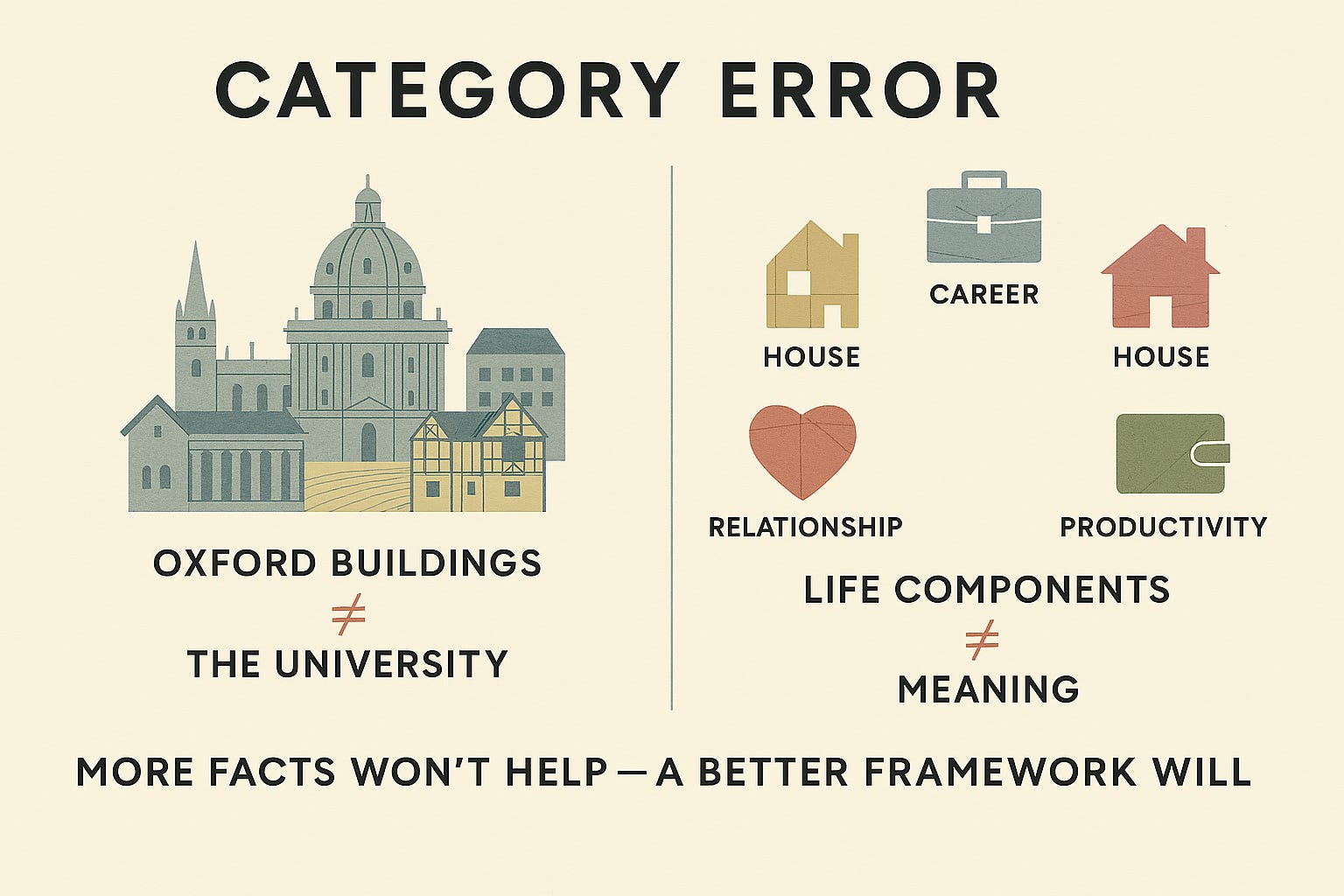
In 1949, the Oxford philosopher Gilbert Ryle published The Concept of Mind, and in it he told a story that has since become one of the most cited thought experiments in philosophy. A visitor is shown around the colleges, libraries, playing fields, and administrative offices of Oxford University. After the tour, he asks: “But where is the University?” He has seen the buildings, the grounds, the faculty, the students. He wants to know where the university itself is.
The joke, of course, is that there is no university distinct from its components. The visitor has made what Ryle called a category mistake: he has assigned a concept to the wrong logical type. He is looking for a thing of one kind—an additional building, a central hub—when the university is actually a thing of a different kind altogether: an institution, a pattern of relationships, an organized set of activities. The error isn’t empirical. He doesn’t need more facts to correct it. He needs a different framework for what kind of entity he’s looking for.
Ryle coined the phrase to attack Cartesian dualism—the idea that the mind is a “ghost in the machine,” a separate substance somehow inhabiting the body. But the implications of category error as a cognitive phenomenon extend far beyond philosophy of mind. They reach into the architecture of how humans build their lives: how they choose careers and relationships, how they pursue meaning, how they construct identity, and why—despite sustained effort, genuine intelligence, and apparently rational choices—so many people arrive at a point in their lives where everything they’ve built feels hollow, foreign, or wrong.
The midlife crisis, the existential breakdown, the sudden recognition that you’ve been optimizing the wrong thing for a decade or two—these are not psychological weaknesses or failures of character. They are the predictable, structurally inevitable consequence of operating with the wrong map. They are the correction signal that occurs when a category error, accumulated across years, finally becomes too expensive to ignore.
Understanding why requires a journey through philosophy, cognitive science, sociology, developmental psychology, systems theory, psychoanalysis, and anthropology. The destination is a realization that most people find both disturbing and liberating in equal measure: the crisis isn’t the problem. It is, in a very precise sense, the solution.
I. The Architecture of the Error: What a Category Mistake Actually Is
Ryle’s original formulation is crisp but limited—it addresses conceptual confusion in philosophical argument. The richer account of category error as a life phenomenon requires expanding the concept considerably.
Bertrand Russell, working several decades earlier on the foundations of mathematics, encountered a related problem in formal logic. He discovered that certain paradoxes—including the famous paradox of the set of all sets that don’t contain themselves—arose from confusing levels of abstraction: treating a set and a set of sets as if they belonged to the same logical type. His solution was the Theory of Types: a formal requirement that objects be categorized by their level of abstraction, and that operations appropriate to one level not be applied to another. Mixing types produces paradoxes that look meaningful but are in fact incoherent.
Gregory Bateson, the anthropologist and cyberneticist who may be the most underread important thinker of the twentieth century, extended Russell’s insight into a general theory of communication and mind. His concept of logical typing proposed that all communication, all thought, and all behavior operates at multiple levels simultaneously—and that the most destructive confusions are not factual errors at a single level, but errors about which level one is operating at. In his analysis of the double bind—a communication pattern he identified as a contributing factor in schizophrenia—the pathological element was not any particular false statement, but the impossibility of correctly identifying what level of communication was occurring. You cannot escape a double bind by getting better at the game; you have to recognize that you’re playing the wrong game.
This is precisely what happens in life-scale category errors. The problem is not that people choose wrong options within a correct framework. It is that they are operating within the wrong framework entirely—and because the framework itself is invisible, no amount of optimization within it produces the results they’re looking for.
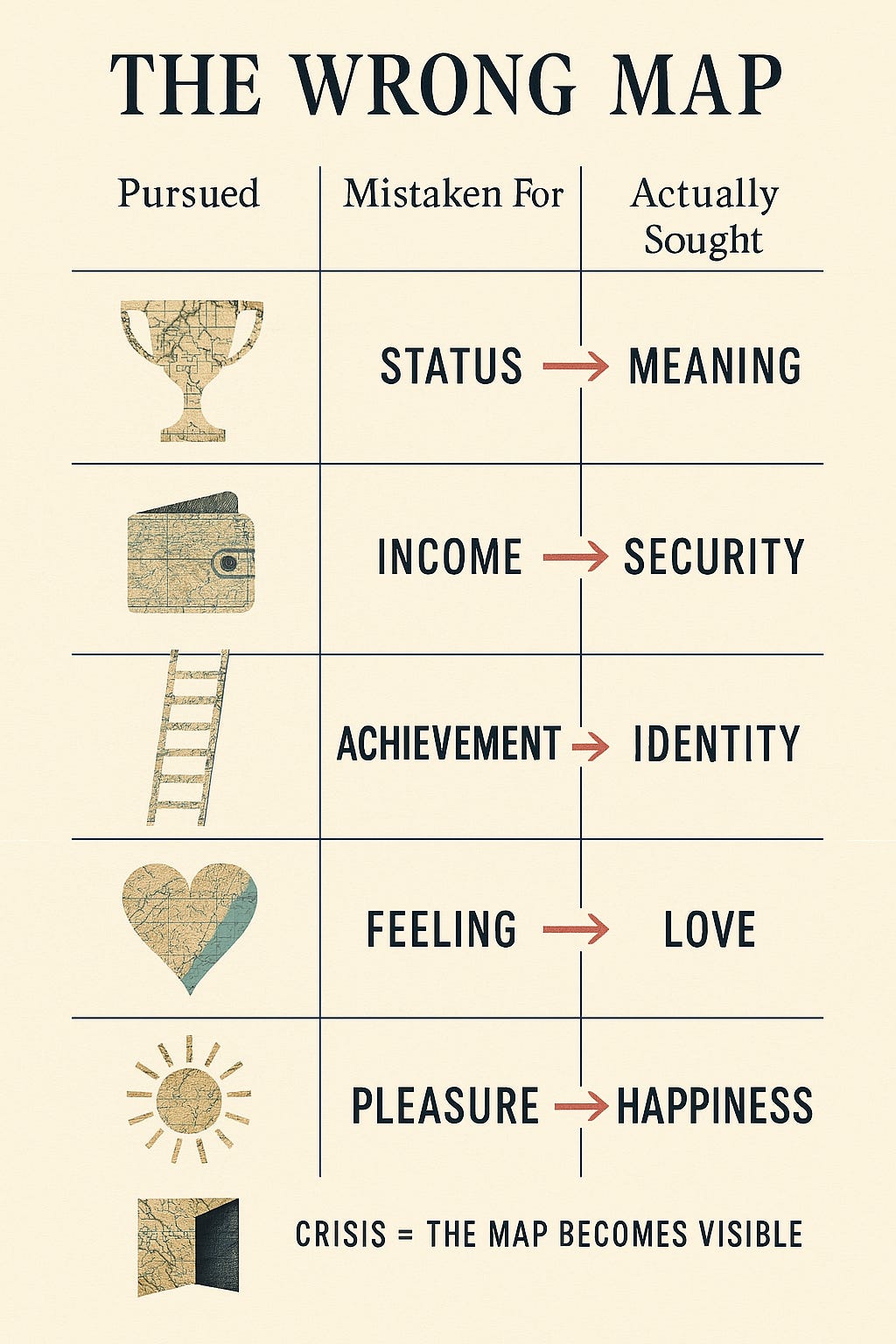
Consider the person who spends twenty years climbing a corporate hierarchy because they believe—genuinely, not self-deceptively—that status and achievement are the mechanisms through which they will experience meaning and respect. They are not wrong to value meaning and respect. They are wrong about the type of thing that produces them. Status is a social signal. Meaning is a phenomenological state. They are not the same kind of entity, and acquiring one does not reliably produce the other. You cannot get to Paris by becoming an expert navigator of the road to Rome, no matter how skilled you become.
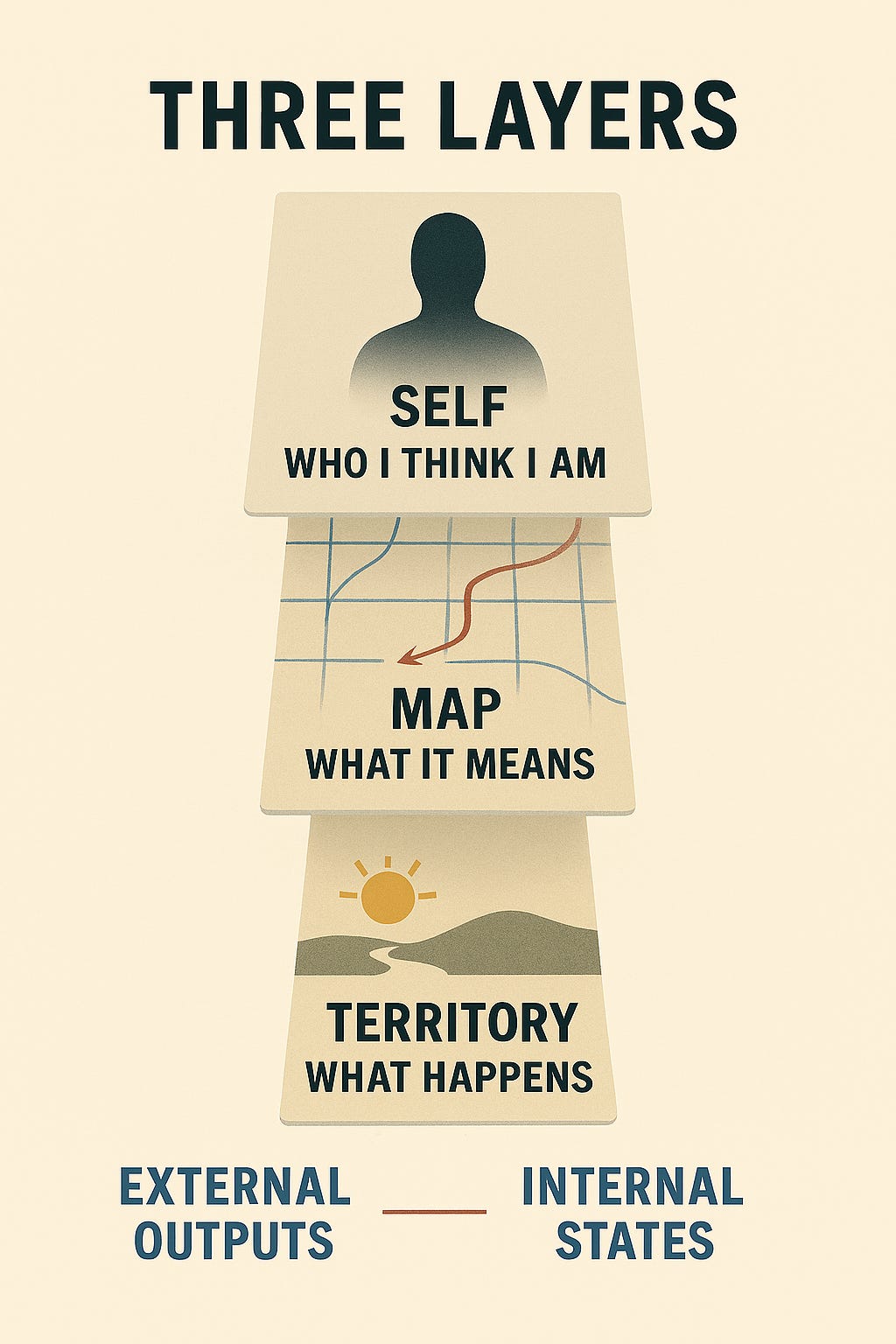
The reason this error is so common, and so persistent, is that it is almost never self-evident. Category errors feel internally coherent. The person pursuing status as a proxy for meaning does not experience their pursuit as confused. They experience it as rational, even virtuous—they’re working hard, achieving things, building a life. The error is invisible because it is operating at the level of the map, not the territory. And we navigate by maps; we don’t typically question them while we’re using them.
II. The Predictive Brain and the Conservatism of Mental Models
Why are humans so prone to category errors? And why, once established, do they persist so stubbornly against contradictory evidence?
The neuroscientist Karl Friston’s framework of predictive processing offers the most compelling current account of how the brain works, and it explains both questions simultaneously. On this view, the brain is not primarily a reactive system that processes incoming sensory data and generates responses. It is primarily a predictive system—one that continuously generates models of the world, uses those models to predict incoming sensory data, and only processes the parts of sensory data that differ from prediction (the “prediction error”). The brain, on this account, is in the business of minimizing surprise: its fundamental drive is to make the world as predictable as possible.
This architecture is extraordinarily efficient. It is why you can navigate a familiar route while thinking about something else entirely. The route is so well-modeled that almost no conscious processing is required; the prediction errors are negligible. It is why you immediately notice when something in your kitchen has been moved—your prediction is violated, and the violation demands attention.
But this architecture has a profound conservative bias: it systematically favors prediction refinement over model revision. When prediction errors occur, the brain has two options. It can update the prediction—the low-cost, high-frequency response. Or it can revise the model—the high-cost, disruptive response that requires reconceptualizing entire domains of experience. Almost always, it tries the first option first, and second, and third. Model revision is expensive, destabilizing, and resisted.
In practical terms: when your framework for understanding your life produces outcomes that don’t match expectations, your first response is not to question the framework. It is to work harder within it, to look for tactical errors, to blame external circumstances, to find ways to interpret the discrepancy as consistent with your model. The model—the category in which you’ve placed your life—is protected by cognitive immune systems far more robust than we typically acknowledge.
The psychologist Leon Festinger documented this process with disturbing precision in his 1956 study of a doomsday cult whose members had sold their possessions in anticipation of an apocalypse that failed to arrive. The prediction of the most dramatic kind had been directly, undeniably falsified. What happened? The members’ belief did not weaken. It intensified. Festinger’s theory of cognitive dissonance described the psychological mechanism: when behavior and belief are inconsistent with reality, the mind does not first revise belief—it first generates rationalizations that reconcile behavior with belief, and reality with both. Changing the behavior (rejoining the world, acknowledging the loss) is more threatening than doubling down on the model.
Applied to life-scale category errors, this explains one of the most puzzling phenomena in human psychology: the capacity of intelligent, reflective people to continue in a manifestly unrewarding direction for years, often decades. It is not stupidity. It is the predictive brain doing exactly what it is designed to do: protect its models from revision, because models are expensive and revision is destabilizing.
III. The Social Calcification of Categories: Bourdieu and the Habitus
The brain’s conservative bias does not operate in isolation. It operates within social structures that actively reinforce it—and this reinforcement is, in the work of the French sociologist Pierre Bourdieu, the key to understanding why category errors become so durable.
Bourdieu’s concept of habitus is one of the most powerful and least understood ideas in twentieth-century social science. The habitus is the system of durable, transposable dispositions that an individual develops through their social experience—their upbringing, education, class position, and cultural environment. It is not a set of explicit beliefs or rules. It is a set of trained instincts: unreflective preferences, embodied responses, intuitions about what is normal, desirable, possible, and appropriate.
The habitus is, in Bourdieu’s phrase, “history made second nature.” The social world that shaped you has been internalized so thoroughly that it no longer appears as external constraint but as personal preference, individual character, natural temperament. When someone from a working-class background experiences the academic world as hostile territory, or when someone from an aristocratic family experiences certain types of work as beneath their dignity, they are not simply responding to external cues. They are expressing an internalized map of social space that was written by their experience and feels like identity.
The critical implication for category errors is this: the categories through which you understand your life—the framework that tells you what success means, what relationships are for, what work should feel like, what constitutes a good life—are largely not chosen. They are inherited. They were installed by your social world before you had the cognitive capacity to evaluate them, and they are maintained by the ongoing pressure of the social field in which you operate.
Bourdieu observed that the habitus tends to generate what he called reasonable expectations: aspirations and strategies calibrated to what the social world suggests is available to someone like you. This calibration is often accurate—social structures are real, and ignoring them is costly. But the calibration is not always accurate, and its inaccuracies are invisible from the inside. The child who internalizes a framework in which intellectual ambition is inappropriate for someone of their background isn’t making a conscious choice to limit themselves. They are expressing a habitus. The young professional who pursues a career in finance because everyone in their social world does so and it is what “success” looks like in that field isn’t making a category error in any simple sense—they are acting out a socially coherent script. The error only becomes visible later, if and when they discover that the category (financial success) doesn’t produce the experience (meaning, satisfaction, identity) they were implicitly expecting.
What makes this so resistant to correction is that the social field actively enforces the categories. Your peers, your family, your professional network, your online environment—all of these continuously signal which categories are legitimate and which are not. Deviation from the socially sanctioned framework doesn’t just feel internally uncomfortable; it risks the loss of social belonging, the withdrawal of recognition, the experience of exile from the community whose validation sustains your sense of self. The category error is therefore not merely cognitive. It is structurally embedded in social life and protected by the enormous force of belonging.
IV. The Levels of Mind: Kegan and the Developmental Dimension
The most sophisticated account of how category errors evolve across a life—and why the crisis that corrects them is not only predictable but developmentally necessary—comes from the work of the Harvard developmental psychologist Robert Kegan.
Kegan’s theory, developed across The Evolving Self and In Over Our Heads, describes mental development not as the accumulation of knowledge but as a series of qualitative transformations in the structure of knowing. He builds on Piaget’s foundational work but extends it across the full lifespan, describing a sequence of what he calls “orders of mind”—each a more complex, inclusive, and flexible framework for making sense of experience.
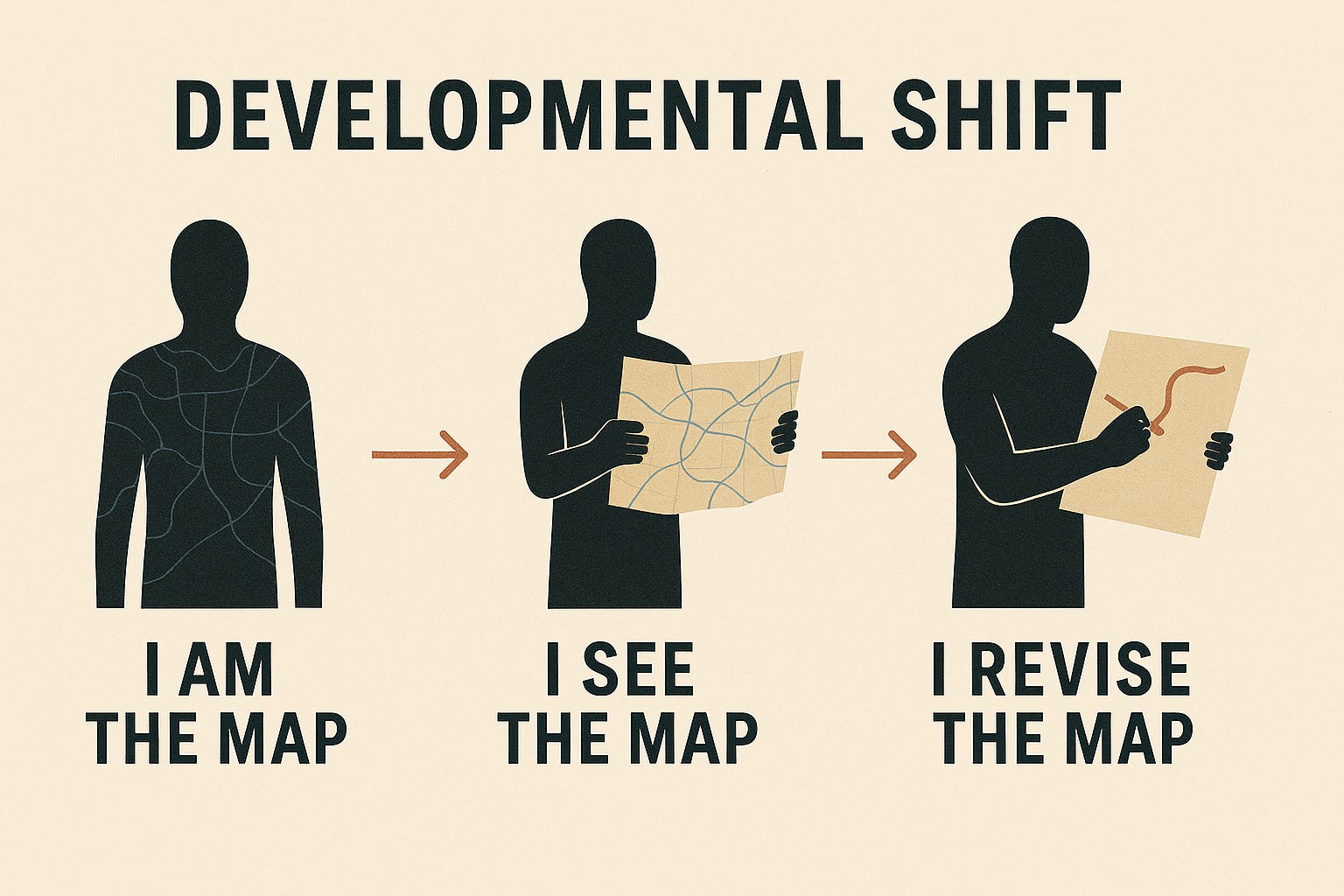
The crucial dynamic in Kegan’s model is the relationship between what he calls the subject and the object of experience. What is subject is what you are identified with, embedded in, unable to see because you are seeing through it. What is object is what you can hold at a distance, reflect on, and operate upon. Development, in Kegan’s framework, is the repeated process by which what was once subject becomes object: what you once were, you can now see.
This has a direct bearing on category errors. The categories through which you understand your life—the frameworks that tell you what success means, what relationships are for, what kind of person you are—are, at any given point in development, largely subject. You don’t have them; you are them. And because you are them, you cannot see them. You cannot question a category you are embedded in any more than you can question the rules of a language you are speaking—at least not until you encounter another language, or until someone points out that language has rules at all.
Kegan’s developmental sequence describes roughly three major transitions in adult life. In what he calls the third order of mind—the “socialized mind”—the individual’s sense of self is constituted by relationships, group memberships, and the expectations of significant others. Success means meeting these expectations; failure means falling short of them. This is the order of mind at which most adults operate most of the time, and it is the order at which most category errors are established: you adopt the framework of the significant groups in your life—family, culture, profession, social class—because that framework is, quite literally, who you are.
The transition to the fourth order—what Kegan calls the “self-authoring mind”—is one of the most significant developmental events of adult life. At this order, you are able to take the expectations and frameworks of others as object rather than subject: you can examine them, evaluate them, and choose among them rather than simply inhabiting them. But this transition is not a smooth, gradual upgrade. It is experienced as a crisis: the dissolution of the frameworks that previously constituted your sense of self, followed by the disorienting work of constructing a new, more internally generated identity.
This developmental account explains something that purely cognitive theories of category error miss: the phenomenology of the correction. The crisis that accompanies the recognition of a life-scale category error does not feel like updating a belief. It feels like losing yourself. And in a sense, it is: the self that was constituted by the category is dissolving. What Kegan calls “subject becoming object” is experienced as the ground disappearing. The terror is real. So is the developmental necessity.
V. Systems and Levels: Why Working Harder at the Wrong Level Produces Nothing
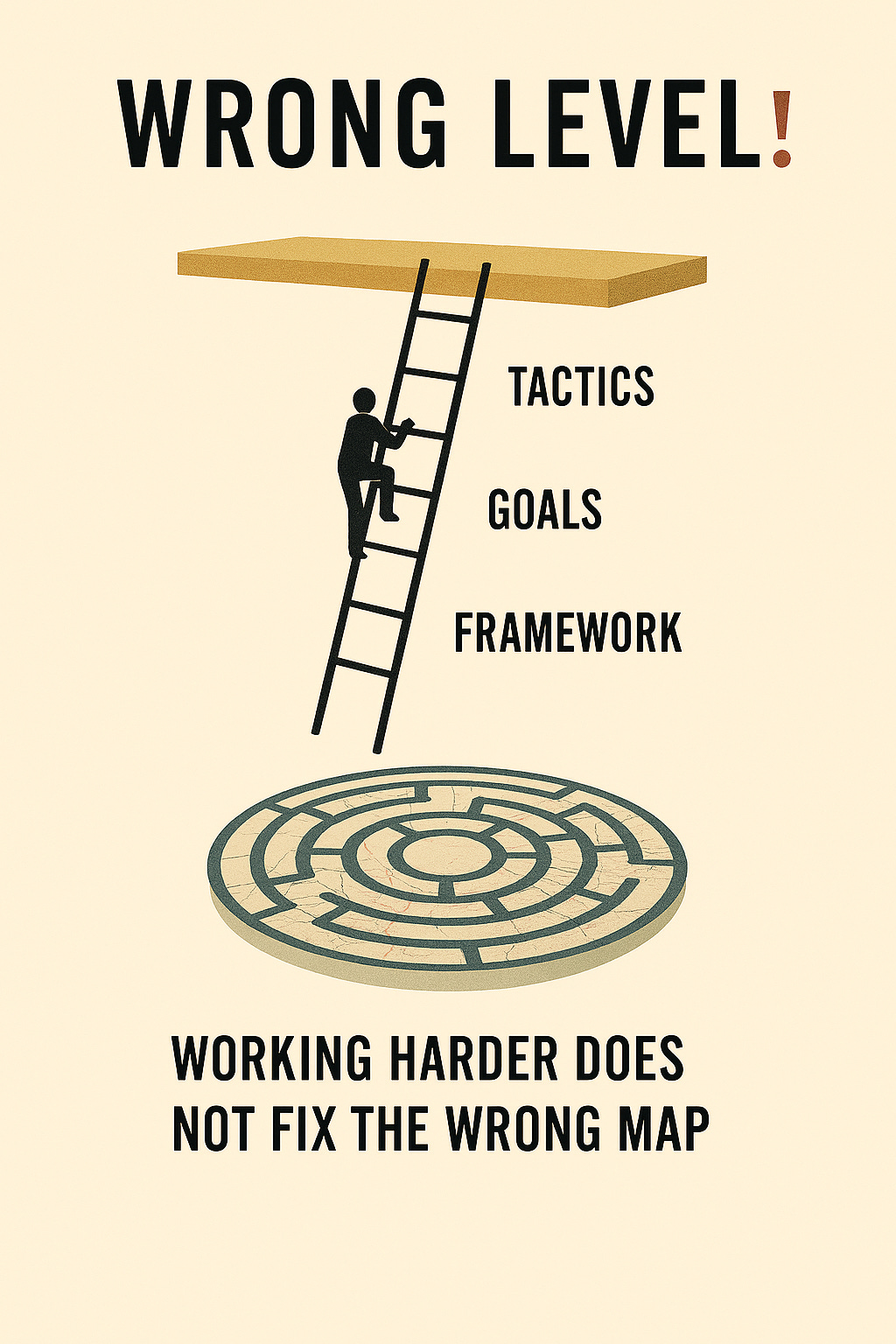
Gregory Bateson distinguished several levels of learning, of which the most important distinction for our purposes is between Learning I (learning within an existing framework—acquiring new information or skills) and Learning II (learning about the framework itself—changing the premises upon which Learning I is based). He observed that most human learning is Learning I, and that Learning II—which he called deutero-learning—is both rarer and far more transformative.
Donella Meadows, in Thinking in Systems, identified the “places to intervene in a system” in order of leverage—from lowest to highest. The lowest-leverage interventions are adjustments to numbers within the existing system: changing a tax rate, modifying a policy parameter, working harder at the existing strategy. The highest-leverage interventions are changes to the system’s goals, its feedback structure, and ultimately the paradigm from which the system operates. She observed, crucially, that most human attention goes to the low-leverage interventions—tweaking parameters—while the high-leverage points go unaddressed, often unrecognized.
This is the systems-theory account of why sustained effort in a wrong category produces nothing: all the effort is being applied at Learning I while the problem is at the level of Learning II. You are adjusting the parameters of a system whose structure is wrong. No amount of parameter adjustment corrects a structural problem. The system continues to produce its characteristic outputs regardless of how hard you work within it.
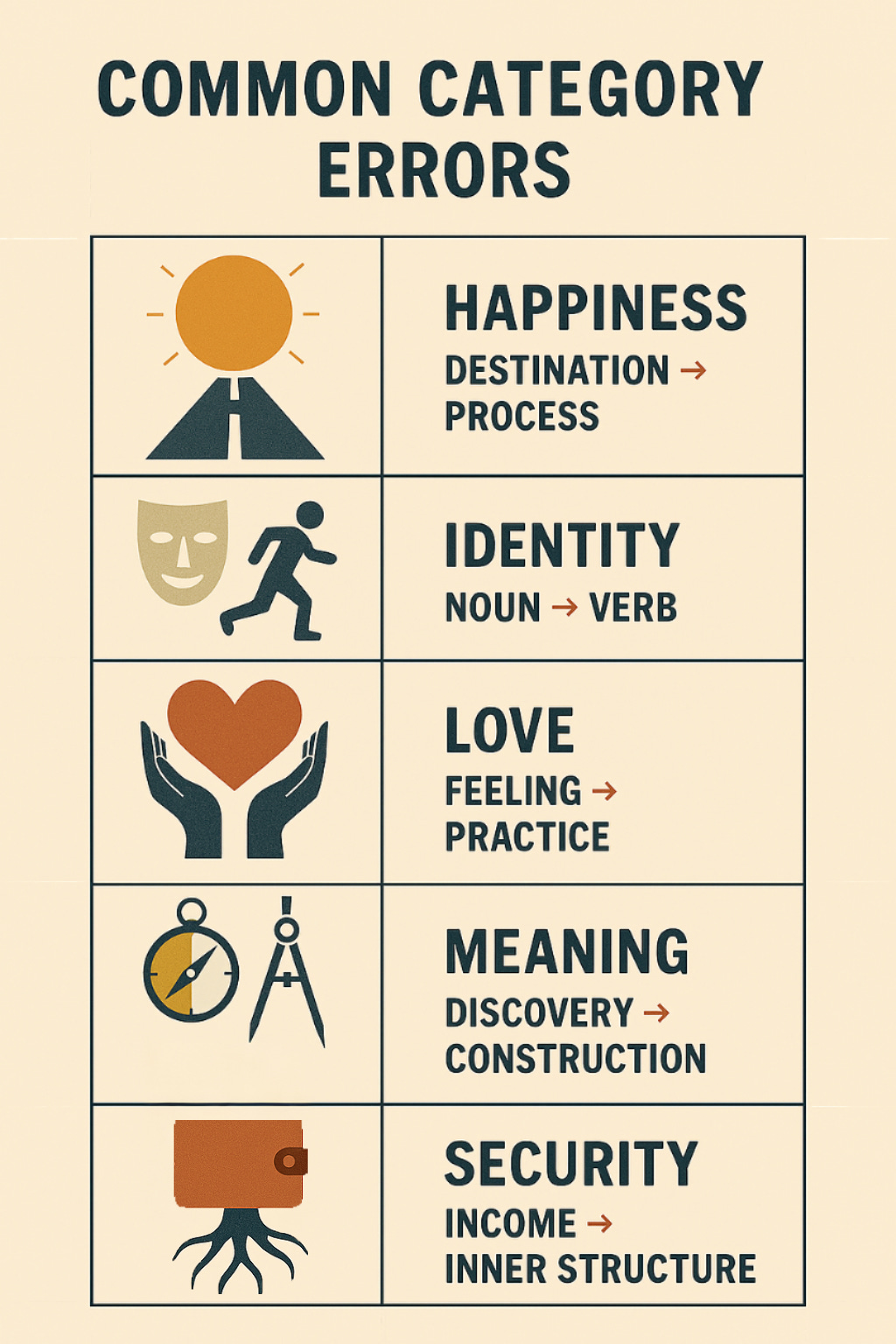
The person who spends fifteen years climbing a career ladder in pursuit of security, only to discover that no amount of income reduces their felt sense of precariousness, is a systems example of exactly this phenomenon. Security is not a function of income; it is a function of the internal structures—attachment patterns, threat sensitivity, regulatory capacity—that determine how one relates to uncertainty. No income level produces security if the underlying system generates insecurity. Kegan would say they were working at the wrong level. Meadows would say they were adjusting parameters rather than structure. Bateson would say they were engaging in Learning I when the problem required Learning II. They are all describing the same phenomenon.
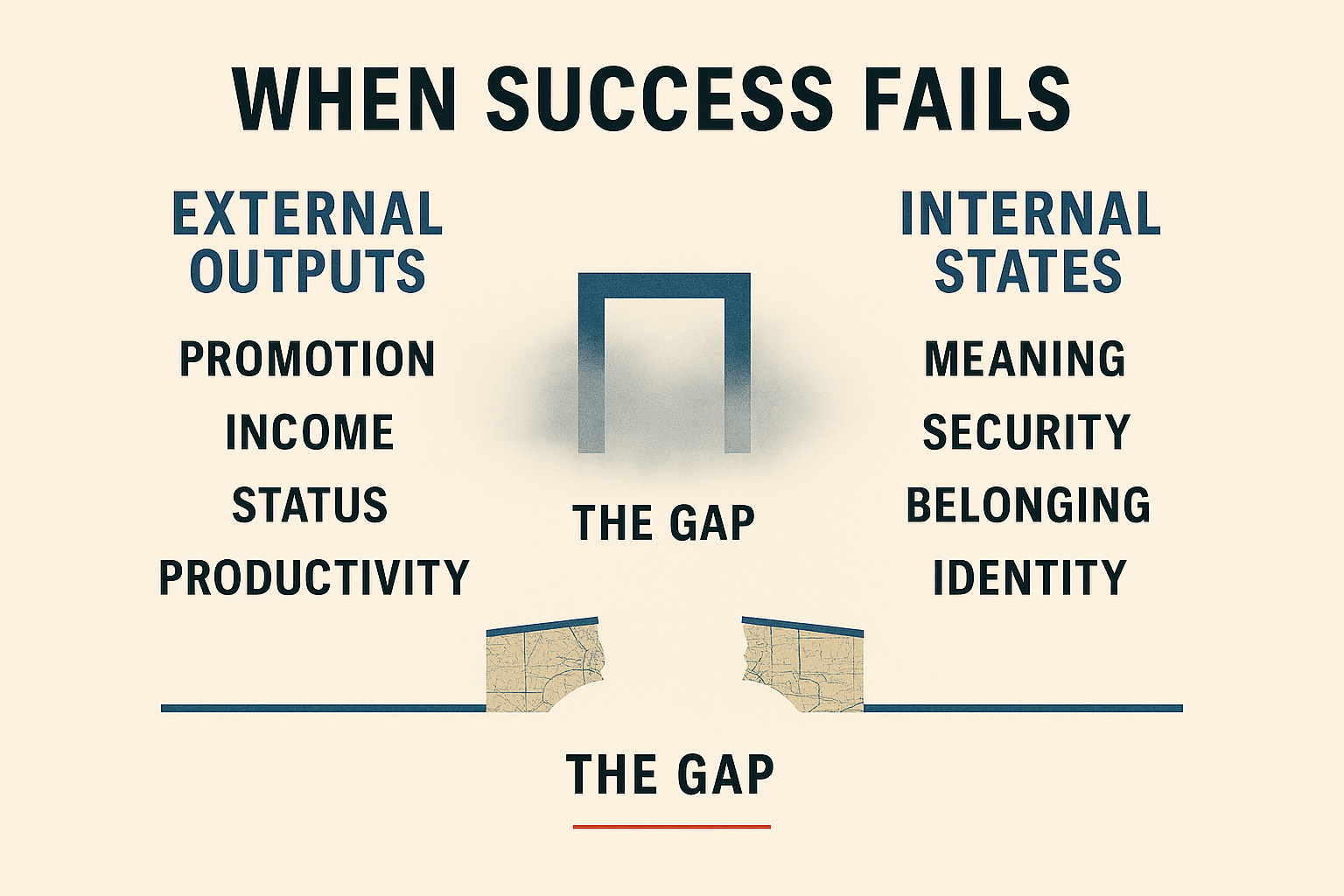
What makes this particularly insidious is that Learning I produces real results. The person climbing the career ladder does get promoted. They do earn more. They do receive the social signals of success. This is the feedback that reinforces the category error: the system is responsive to effort, so the effort feels productive. It is only when the accumulated gap between the effort’s outputs (status, income, achievement) and the desired experience (security, meaning, identity) becomes too large to rationalize that the category error becomes visible.
VI. The Phenomenology of the False Life: Sartre, Winnicott, and the Authenticated Self
Two thinkers, working from entirely different traditions, provide the most vivid accounts of what it feels like to live inside a category error.
Jean-Paul Sartre’s concept of bad faith (mauvaise foi) describes the human tendency to live as if one’s existence were defined by external necessity—by roles, social expectations, or fixed identity—rather than by freedom. The waiter who performs the role of waiter with such perfect mechanical precision that he seems to have forgotten he is choosing to be a waiter, moment by moment: this is Sartre’s image of bad faith. The error is not self-deception in a simple sense; it is a more fundamental confusion about the type of thing one is. A human being is not a thing with fixed properties; it is a being that constantly constitutes itself through choices. To live as if one’s identity were fixed and given—by one’s profession, one’s nationality, one’s family role—is to mistake a process for a state, and to inhabit the mistake as if it were a home.
The phenomenology of bad faith—the internal experience of living within it—is one of subtle but persistent wrongness. Not dramatic suffering, at least not initially. A sense of going through motions. Of performing a life rather than living one. Of knowing one’s lines without believing in the play. Sartre’s claim is that this wrongness is always present at some level, even when suppressed, because the freedom that constitutes human existence cannot be permanently denied—only temporarily disguised.
The British psychoanalyst D.W. Winnicott approaches the same territory from a clinical rather than a philosophical direction with his concept of the false self. In Winnicott’s developmental theory, the false self is a defensive structure that forms in response to inadequate early mirroring—situations in which the child’s authentic, spontaneous gestures are consistently met with the caregiver’s own needs rather than responsive recognition. The child learns to adapt to the caregiver’s world, suppressing and eventually losing contact with their own desires, and developing instead a highly competent, socially functional persona built around meeting others’ expectations. The false self is not pathological in a dramatic sense. It can be highly successful. It can build careers, maintain relationships, and achieve social recognition. What it cannot do is generate genuine satisfaction, because it is not connected to the genuine self whose satisfaction would require genuine expression.
Winnicott observed that the false self often begins to crack in midlife, when the external achievements that it pursued—the career, the family, the social standing—have been sufficiently accomplished that they can no longer serve as a horizon. When the destination is reached and the traveler discovers that it was the wrong destination, the defense collapses. The crisis that follows is not pathological. It is the genuine self, which has been suppressed for decades, beginning to insist on its existence.
Together, Sartre and Winnicott describe the two dimensions of life inside a category error: the philosophical dimension (living as a fixed thing rather than a free process) and the psychological dimension (performing a socially constructed self rather than expressing an authentic one). These are not identical accounts, but they converge on the same phenomenological signature: the persistent, growing sense that something is fundamentally wrong—not with the choices one has made, but with the framework within which all the choices were made.
VII. The Accumulation of Misdirected Effort: Compound Error and the Sunk Cost of Identity
There is a financial concept called sunk cost: money already spent that cannot be recovered, which rational analysis says should not influence future decisions. Humans are systematically bad at ignoring sunk costs. We continue failed projects, stay in wrong relationships, and persist in bad strategies, in part because of what we have already invested. This is irrational in a narrow economic sense, but it is deeply rational in a psychological one: the sunk cost represents not just money but identity. To abandon a project in which you’ve invested years is not merely to lose the investment; it is to invalidate the person who made it.
Applied to category errors, the sunk cost dynamic creates what might be called compound error: the longer a category error persists, the more investment accumulates around it, and the more psychologically costly correction becomes. This is not a linear process. It is exponential, in the same way that compound interest is exponential. Each year of investment in the wrong category—career choices made on the basis of the wrong definition of success, relationships formed around the wrong understanding of what intimacy requires, identities constructed around the wrong account of what gives life meaning—creates more to lose, more to validate, more to protect. The self becomes, over time, constituted by the error. Correcting it is not just changing your mind. It is dismantling the person you have built.
The sociologist Everett Hughes introduced the concept of a career in the broadest sense—not just a professional trajectory, but any ordered sequence of social positions through which a person moves over time. He observed that careers have a characteristic feature: each position makes the next one more or less probable, not only by developing certain skills, but by closing certain possibilities and opening others. A life is a career in this sense: each decision reduces the option space for subsequent decisions. And the accumulation of decisions within a particular category creates what Hughes called career contingencies—structural constraints that make it increasingly difficult to change direction even when the direction is recognized as wrong.
These contingencies are not merely external. They are internalized as identity. The physician who recognizes at fifty that they should have been a musician has not merely made an opportunity cost calculation. They have confronted the fact that they are a physician—their relationships, their social world, their self-conception, their daily habits, their sense of competence—all of this is organized around a category that, they now suspect, was always wrong. The distance between where they are and where they feel they should be is not a gap in space, traversable by a simple journey. It is a gap in identity, which requires the dismantling of a self.
Viktor Frankl, writing from the extreme case of Auschwitz, observed something relevant here. In Man’s Search for Meaning, he documented that the prisoners who collapsed first under the conditions of the camp were not necessarily the physically weakest. They were those who had built their entire sense of meaning around external structures—professional identity, social roles, material comfort—that the camp had stripped away. The capacity to survive—psychologically more than physically—was correlated with access to a meaning that was not contingent on external conditions. Frankl’s logotherapy, developed from this observation, placed the construction of meaning at the center of psychological health. What he identified in extreme form is a milder version of what occurs in any life-scale category error: when the external structures that the meaning was attached to are removed or revealed as insufficient, the meaning collapses. And when meaning collapses, the accumulated investment in the wrong category becomes fully visible—often for the first time.
VIII. The Invisible Progress Problem: Why You Can’t See That You’re Lost
One of the defining characteristics of life inside a category error is the absence of reliable feedback. This is not accidental; it is structural, and understanding why requires a brief detour into information theory and the nature of feedback systems.
In a well-functioning feedback system, action produces outputs, those outputs are measured against a target, and the discrepancy between actual and desired output generates a correction signal. This is how a thermostat works, how biological homeostasis works, and how, in principle, human learning should work. The problem with life-scale category errors is that the feedback loop is broken—not because the world doesn’t send signals, but because the signals are being interpreted through the wrong framework.
Return to the person pursuing status as a proxy for meaning. When they achieve a promotion, they receive a genuine signal of progress—within the domain of status. Their framework tells them this is a meaningful step toward the thing they’re actually seeking. The signal is real; the interpretation is wrong. Meanwhile, the signals that would indicate the absence of meaning—the persistent flatness, the absence of genuine satisfaction, the vague wrongness that refuses to go away—are systematically misread as problems with execution rather than problems with the framework. “I need to achieve more before I feel satisfied.” “I haven’t quite made it yet.” “I’ll feel differently when I reach the next level.” These are rationalizations that preserve the framework by reinterpreting the negative feedback as evidence for more effort, not less.
The information theorist Claude Shannon defined information as reduction of uncertainty. Paradoxically, a category error can produce what looks like a lot of information—promotions, achievements, milestones, feedback from others—while systematically failing to reduce uncertainty about the thing that actually matters. You receive dense information about your progress through the wrong landscape. You receive almost no information about whether you are in the right landscape at all. This is the information poverty that characterizes sustained category error: not a lack of data, but a lack of data about the right things.
The philosopher Michael Polanyi described knowledge as involving both focal and tacit dimensions. Focal awareness is directed toward the explicit object of attention—the goal you’re pursuing, the metric you’re tracking, the achievement you’re working toward. Tacit awareness is the background knowledge from which focal awareness operates—the framework, the assumptions, the sense of orientation that you bring to the task. Polanyi’s crucial observation was that you cannot simultaneously focus on the tacit and the focal; attending to the background necessarily means releasing attention on the foreground. Operating within a category error is operating in a mode of exclusive focal awareness: you can see the territory you’re navigating, but you cannot simultaneously see the map that tells you whether the territory is where you want to be.
This is why the correction signal, when it arrives, typically comes not through the accumulation of focal information but through a different mode of awareness entirely—what the Zen tradition calls satori, what psychologists call insight, what ordinary language calls a moment of clarity. Something shifts in the background, not the foreground. The map becomes visible, and in becoming visible, it reveals itself as wrong. This shift cannot be produced by trying harder within the existing framework. It requires—and this is the uncomfortable truth—some form of disruption sufficient to force attention away from the focal and toward the tacit.
IX. The Crisis as Paradigm Shift: Kuhn and the Structure of Necessary Revolutions
Thomas Kuhn’s The Structure of Scientific Revolutions is ostensibly about how science progresses, but its real subject is how any framework-dependent inquiry handles the discovery that its framework is wrong. The concept he introduced—the paradigm shift—has been so thoroughly absorbed into popular discourse that its original technical meaning has been diluted. In Kuhn’s original formulation, it describes something far more radical and far more instructive than mere change or innovation.
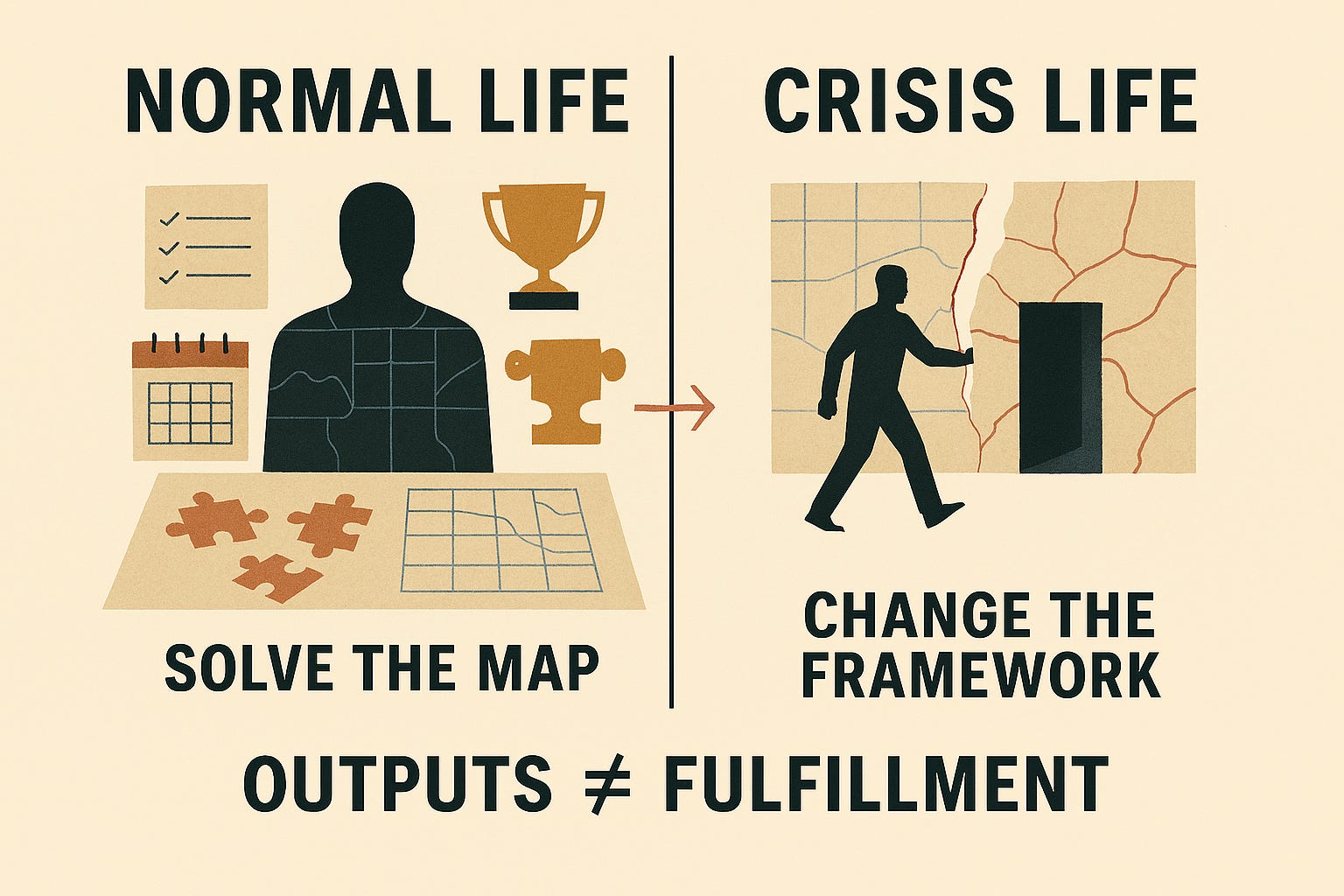
Normal science, in Kuhn’s account, is the activity of solving puzzles within an established framework. The framework—the paradigm—defines what counts as a legitimate question, what counts as an acceptable answer, and what methods are appropriate for generating answers. Scientists working within a paradigm do not regularly question the paradigm; they work within it, and their work presupposes it. This is not naivety; it is necessary efficiency. You cannot do science and simultaneously question whether science is the right activity.
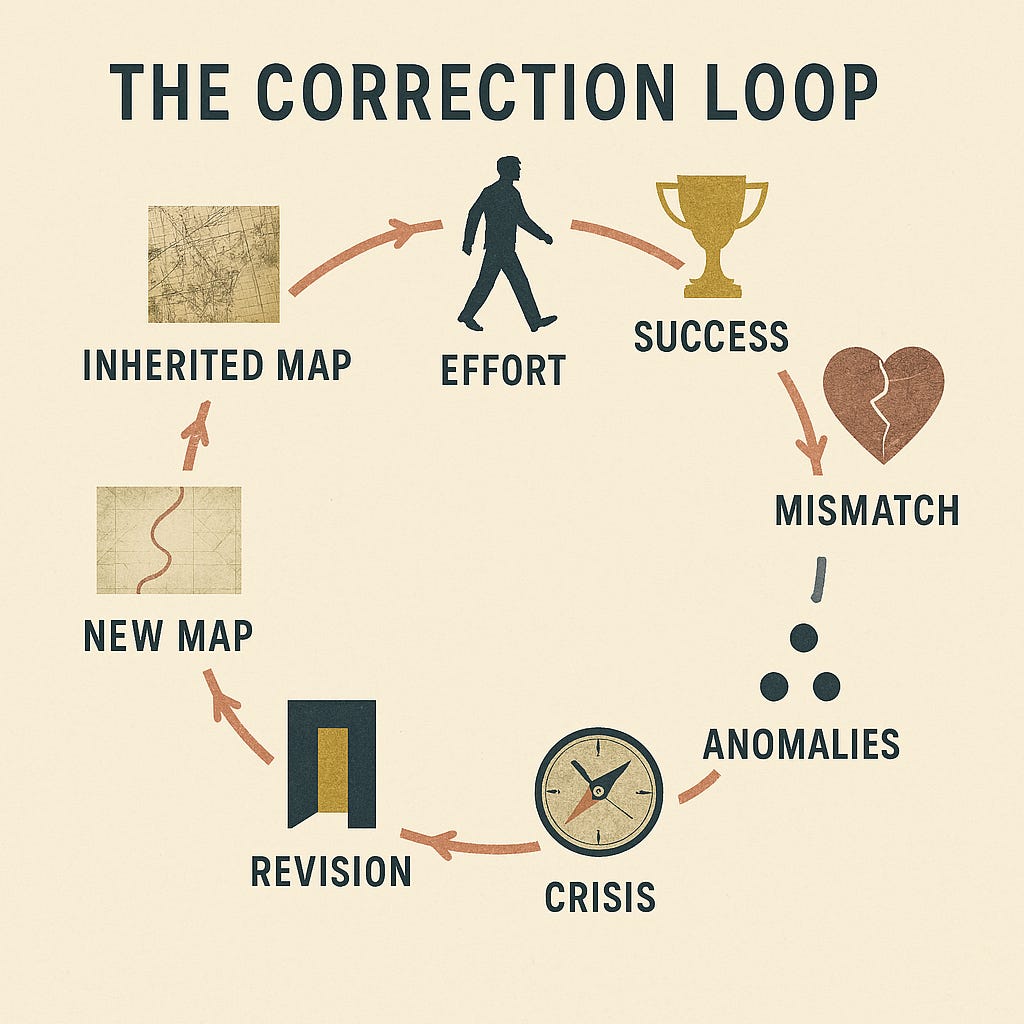
Normal science, however, generates anomalies: results that don’t fit the paradigm, phenomena that the framework cannot explain. In the early stages, anomalies are dismissed, explained away, or set aside as problems to be solved later. Kuhn showed, through detailed historical case studies, that this is precisely what scientists do: they protect the paradigm against anomalies through a variety of defensive maneuvers—auxiliary hypotheses, methodological adjustments, attributions of error—that preserve the framework while accounting for the discordant data.
But anomalies accumulate. And when they accumulate sufficiently—when the weight of unresolved anomalies reaches a critical threshold—a crisis occurs. The crisis is not merely intellectual; it is social, psychological, and often personal. Scientists invested in the old paradigm experience the crisis as a threat to their identities as well as their theories. The resolution of the crisis—the paradigm shift—is not a gradual, smooth process of evidence accumulation. It is a gestalt switch: a sudden reorganization of the conceptual field in which the phenomena are seen in an entirely new way, and what were previously anomalies become the central evidence for the new framework.
The analogy to life-scale category errors is not metaphorical. It is structural. Normal living within a category error corresponds to Kuhn’s normal science: systematic, effortful, productive of real results within the framework, and constitutively unable to question the framework itself. The anomalies—the persistent dissatisfaction, the achievements that don’t satisfy, the relationships that follow the same disappointing pattern regardless of partner, the nagging sense of wrongness that refuses to resolve—correspond to Kuhn’s anomalies: signals that the framework can’t explain, which are therefore explained away, suppressed, or attributed to personal failure.
The midlife crisis corresponds to Kuhn’s period of crisis science: the moment when the anomaly load becomes too large to manage, the defensive maneuvers become too costly, and the framework—which is to say, the category in which your life has been organized—becomes visible as a framework rather than as reality. This moment is characterized by exactly the features Kuhn describes in scientific crisis: disorientation, anxiety, loss of the feeling of clear direction, and the partial, fragmentary appearance of new frameworks before any one of them has consolidated into a new paradigm.
Kuhn’s most important insight for our purposes is this: paradigm shifts require crisis. They do not occur through the gradual accumulation of evidence under normal conditions, because under normal conditions the framework is protected against the evidence that would challenge it. The crisis is not an unfortunate disruption of the path toward clarity. It is the mechanism by which clarity becomes possible. There is no route from one paradigm to another that doesn’t pass through the disorientation of crisis. This is as true of lives as it is of sciences.
X. The Rite of Passage: Van Gennep, Turner, and the Anthropology of Threshold
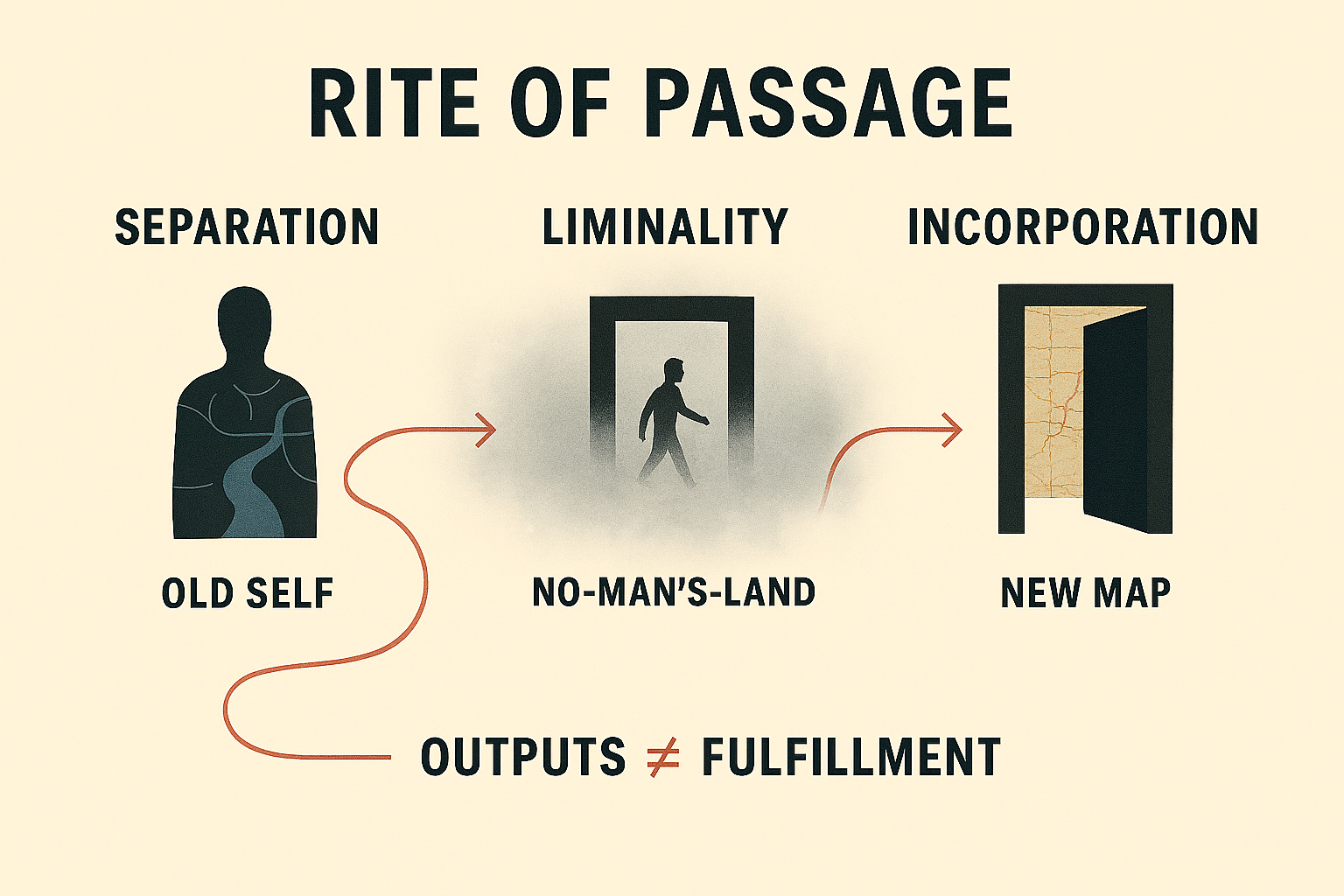
The anthropologist Arnold Van Gennep, writing in 1909, noticed a structural similarity across an enormous range of ritual transitions in human cultures—initiations, weddings, funerals, seasonal ceremonies, rites of healing. He described these transitions as sharing a three-phase structure: separation (removal from the existing social position), liminality (a threshold state of being between positions), and incorporation (entrance into the new social position). His student Victor Turner developed the concept of liminality into one of the most profound ideas in anthropology.
The liminal phase—from the Latin limen, threshold—is the period between. The initiate has left their previous status but not yet arrived at their new one. They are, in Turner’s phrase, “betwixt and between.” Turner documented that liminal figures across cultures share a characteristic set of attributes: they are stripped of status markers, often physically secluded, subjected to ordeals, and described in terms that emphasize their ambiguity—simultaneously everything and nothing, sacred and profane, dangerous and vulnerable. The liminal period is deliberately constructed as a dissolution of structure: the old identity is destroyed, the new one has not yet formed, and the initiate must undergo this void as a precondition for genuine transformation.
Turner’s crucial insight was that liminality is not merely a transition. It is a state with its own properties, and those properties are generative rather than merely destructive. In the absence of normal social structures, liminal subjects develop what Turner called communitas—a mode of human connection stripped of role, status, and hierarchy, experienced as direct, unmediated, and intensely real. The ordeal of the liminal state, precisely because it destroys the pretensions of normal social life, creates the conditions for a different kind of awareness: one that sees what is essential rather than what is socially constructed.
Applied to the midlife or existential crisis, Turner’s framework transforms the meaning of the experience entirely. The crisis is not a breakdown to be treated or a regression to be corrected. It is a liminal state: a socially unstructured, psychologically dissolving, profoundly disorienting threshold through which genuine transformation requires passage. The dissolution of the old identity is not the crisis. It is the first phase of the rite. The second phase—the encounter with what was suppressed, avoided, and unanswered within the old framework—is the ordeal. The third phase—the emergence of a new framework, a new identity, a new category for organizing one’s life—is what all the preceding suffering was for.
Van Gennep observed that cultures which lack adequate rites of passage produce individuals who are structurally liminal for extended periods—people who have left a previous identity without arriving at a new one, who are permanently between. Modern Western societies, with their attenuated ritual life and their systematic pathologizing of crisis, are particularly prone to producing this kind of stuck liminality. When the midlife crisis is treated as a symptom to be managed rather than a transition to be navigated, the individual is offered palliative care when what they actually need is passage.
XI. The Specific Categories Most Likely to Fail
Not all category errors are equally common or equally consequential. Experience and evidence point to several recurring domains where the error most reliably accumulates and most predictably demands correction.
Happiness as destination rather than process. The hedonic treadmill, documented by psychologists Philip Brickman and Donald Campbell in the 1970s, describes the finding that humans rapidly adapt to changes in their circumstances—both good and bad—and return to a relatively stable baseline of subjective well-being. People who win lotteries return, within roughly a year, to approximately their previous happiness level. So do people who become paraplegic. This finding has been replicated extensively, though the adaptation is not as complete or symmetric as the original study suggested. What it demonstrates, at minimum, is that treating happiness as a state to be achieved through the acquisition of circumstances is a category error: happiness is more a function of the process of engaging with life than of the accumulation of outcomes. The person who spends decades accumulating the circumstances they believe will produce happiness is working in the wrong category, and the failure to achieve the expected payoff is not a sign that they need more circumstances. It is a sign that they need a different framework.
Identity as a noun rather than a verb. The philosopher Charles Taylor, in Sources of the Self, argues that modern identity is constituted by orientation toward a moral horizon: a framework of values and commitments that gives life direction and meaning. The category error that generates the most common form of existential crisis is treating identity as a fixed possession—something you have rather than something you continuously enact. Erikson’s concept of identity, though often misread as a once-and-done adolescent achievement, was always intended as a dynamic process of ongoing integration. When circumstances change—when the career that defined you ends, when the relationship that organized your social world dissolves, when the physical capacity that anchored your self-image declines—the person who treated identity as a noun finds themselves in free fall. The person who understood it as a verb finds it has a different kind of continuity, less brittle and more generative.
Love as a feeling rather than a practice. Erich Fromm, in The Art of Loving, argued that the dominant conception of love in modern Western culture commits a category error of this precise kind: it treats love as a noun (a feeling to be had) rather than a verb (a practice to be cultivated). People seek the experience of being in love—the intensity, the dissolution of boundaries, the intoxicating early phase—and organize their lives around finding and maintaining that experience. They fail, repeatedly and bewilderingly, because the experience they are seeking is not what love in the sustaining, deepening sense actually is. The category error produces a characteristic pattern: intense early-stage experience, followed by disappointment when it changes character, followed by either the abandonment of the relationship in search of the feeling elsewhere, or the resignation to a relationship experienced as hollow. Neither is necessary if the category is correctly understood.
Meaning as discovery rather than construction. Perhaps the most widespread and consequential category error in modern life is the treatment of meaning as a pre-existing feature of the world to be discovered, rather than something that is constituted in the act of committed engagement. This is the error Frankl identified, and it produces the peculiar paralysis of those who defer commitment until they find what they are “meant to do”—as if meaning were a signal to be received rather than a project to be undertaken. Irvin Yalom, the existential psychiatrist, documents in his clinical work the frequency with which this category error appears in the presenting complaints of his patients: the feeling that one is waiting for a life that hasn’t quite started yet, that everything so far has been provisional, that the real thing is somewhere ahead. The waiting, in Yalom’s account, is itself the problem. Meaning is not found. It is made—and the making requires the kind of committed action that the waiting prevents.
XII. The Crisis That Corrects: Why Collapse is Also Clarification
The argument of the preceding sections converges on a conclusion that requires explicit statement: the crisis that occurs when a life-scale category error accumulates to critical mass is not primarily a pathological event. It is an epistemological event—a forced update to a framework that normal cognitive processes were systematically protecting against revision.
This does not mean the crisis is comfortable. Kuhn’s paradigm shifts were not comfortable for the scientists who lived through them; many of them, in fact, could not survive the transition and spent the remainder of their careers defending the old paradigm. Van Gennep’s liminal phase was, by design, an ordeal. Kegan’s developmental transitions are experienced as losses before they are experienced as gains. The subjective experience of a forced framework revision is one of the most disorienting and threatening things that can happen to a person, because the framework is not merely a set of beliefs. It is the structure of the self.
But the alternative—the prevention of the crisis through medication, distraction, or doubling down on the existing framework—is not a neutral outcome. It is the perpetuation of the category error. The person who manages their midlife crisis with a sports car, an affair, or an antidepressant—not always, but often—is doing the psychological equivalent of what Kuhn’s crisis-era scientists do when they produce elaborate auxiliary hypotheses to protect the old paradigm: they defer the revision at the cost of accumulating more anomalies, more investment, more identity construction around something that cannot ultimately deliver what it promises.
The productive engagement with the crisis involves something that is both cognitively and emotionally demanding: the willingness to hold the uncertainty without premature resolution. To stay in the liminal state long enough for the new framework to form organically, rather than grabbing the nearest available framework—a new career, a new relationship, a new ideology, a new self-improvement project—that simply replaces one category error with another. The philosopher Keats described this as negative capability: the capacity “of being in uncertainties, mysteries, doubts, without any irritable reaching after fact and reason.” It is precisely the capacity that the predictive brain, with its drive to minimize surprise, makes structurally difficult—which is why the crisis must be acute enough to overwhelm the brain’s normal defensive operations before genuine framework revision becomes possible.
What emerges on the other side—when it goes well—is what Kegan calls a higher order of mind: not a better answer within the old framework, but a more capacious framework that can hold the old one as object rather than subject. The person who has passed through the category crisis has not merely learned new information. They have developed a new relationship to their own knowing. They can hold their frameworks more lightly, question them more readily, revise them with less identity cost. They have learned, in Bateson’s language, not just Learning I but Learning II—how to learn, at the level of frameworks rather than facts. This is perhaps the most valuable thing a human mind can develop, and it is almost exclusively developed through the experience of having discovered that a framework one was deeply embedded in was wrong.
XIII. The Closing Argument: Towards a Cartography of the Right Level
The visitor in Ryle’s story is looking for the university in the wrong place not because he is stupid, but because he is using the wrong category. He has been given a tour of every component and has come away more confused, not less, because the confusion is not at the level of information. It is at the level of type. More facts will not help him. A better category will.
Most people, at some point in their adult lives, are that visitor. They have been given a tour of the components of a good life—achievement, relationship, status, pleasure, productivity, wellness—and they have pursued these components with genuine effort and relative success. And yet something remains absent, elusive, persistently wrong. They keep looking for the university.
The philosophy, cognitive science, sociology, developmental psychology, systems theory, psychoanalysis, and anthropology surveyed in this essay all point to the same diagnosis and the same prognosis. The diagnosis: the absence is structural, not personal. It is the result of operating within a category—a framework for what life should be and what constitutes progress in it—that was largely inherited rather than chosen, that is maintained by social pressure and cognitive immune systems far more robust than self-reflection, and that produces real outputs in the wrong domain. The prognosis: the system will eventually demand correction, because the gap between what the framework promises and what experience delivers accumulates compound interest until it can no longer be managed. The correction, when it comes, will feel like collapse. It is also, always, the beginning of something more accurate.
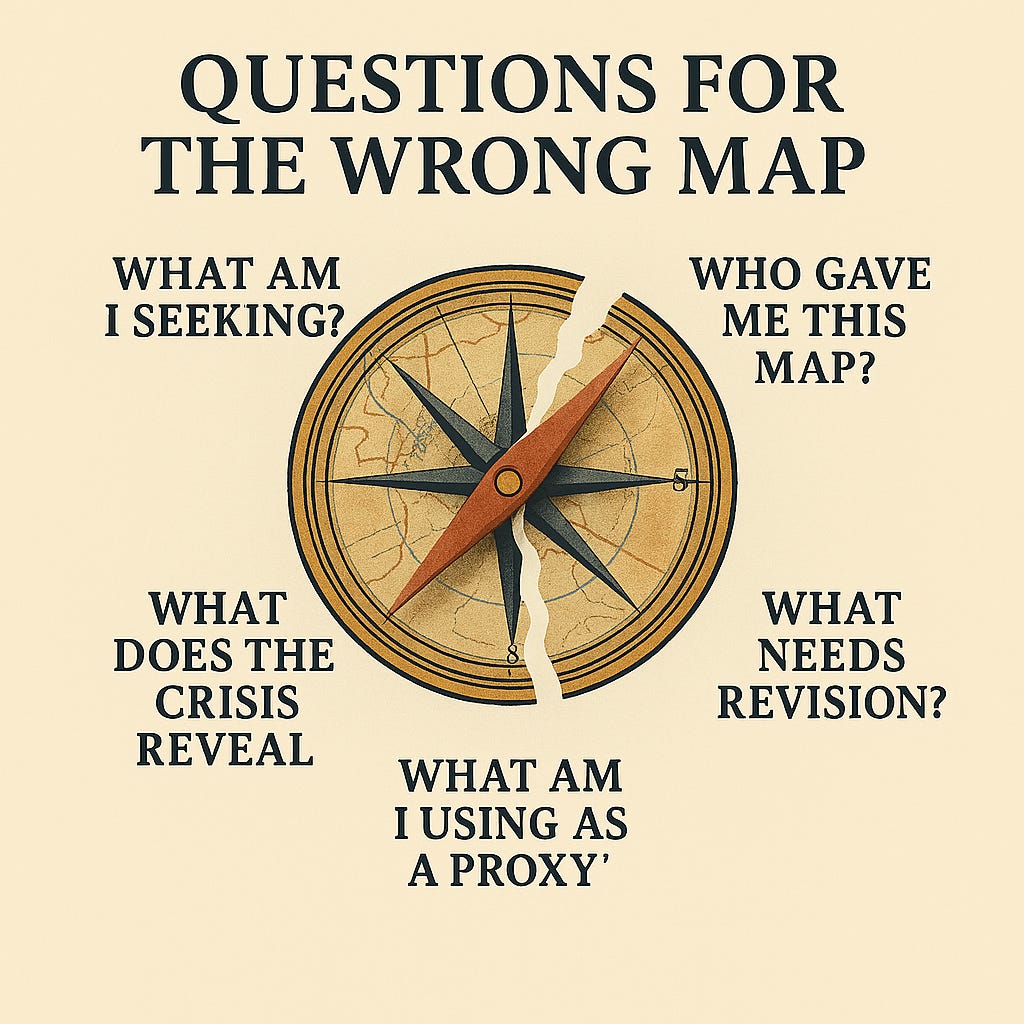
The practical implication—and there is one, though it is uncomfortable—is not that crises should be engineered or sought out. It is that they should be recognized when they arrive, rather than suppressed, managed, or fled. The orienting question is not “how do I get out of this?” but “what is this showing me that I couldn’t see before?” This is not consolation. It is cartography: the use of the crisis as a surveying instrument to locate the level at which the real problem lies.
Because the real problem is never at the level of choices. It is never about which career you should have chosen, which relationship you should have entered, which path you should have taken. All of those questions are downstream of the one that matters: what framework are you using to know what any of these choices is for? What kind of thing do you believe you’re building? What do you take yourself to be?
These are not questions you can answer while embedded in a functioning framework. They only become accessible when the framework cracks. The crisis, in other words, is not the interruption of the examined life. It is its beginning. And the person who can recognize it as such—who can stay in the disorientation long enough to let a more accurate map form—has access to something that no amount of optimization within the wrong category can provide.
They finally know what kind of thing they are looking for.
The intellectual traditions drawn on in this essay, for readers who wish to pursue particular threads: Philosophy of mind and category theory: Gilbert Ryle’s “The Concept of Mind,” Bertrand Russell’s “Principia Mathematica,” Gregory Bateson’s “Steps to an Ecology of Mind.” Cognitive science and predictive processing: Karl Friston’s papers on the free energy principle, Leon Festinger’s “When Prophecy Fails,” Daniel Kahneman’s “Thinking, Fast and Slow.” Sociology and social capital: Pierre Bourdieu’s “The Logic of Practice” and “Distinction.” Developmental psychology: Robert Kegan’s “The Evolving Self” and “In Over Our Heads,” Jean Piaget’s foundational developmental work. Systems theory: Donella Meadows’ “Thinking in Systems,” Gregory Bateson’s “Mind and Nature.” Existential philosophy and psychology: Jean-Paul Sartre’s “Being and Nothingness,” Viktor Frankl’s “Man’s Search for Meaning,” Irvin Yalom’s “Existential Psychotherapy,” Charles Taylor’s “Sources of the Self.” Psychoanalysis: D.W. Winnicott’s “The Maturational Processes and the Facilitating Environment,” Erich Fromm’s “The Art of Loving.” History and philosophy of science: Thomas Kuhn’s “The Structure of Scientific Revolutions,” Michael Polanyi’s “Personal Knowledge.” Anthropology of ritual: Arnold Van Gennep’s “The Rites of Passage,” Victor Turner’s “The Ritual Process.”
This essay is part of a series see index page here