
The Double Bind: Personal Category Errors, Systemic Delusions, and the Compounding of Collapse
Part 05 Of What The Sandpile Knows Essays Series


The Double Bind: Personal Category Errors, Systemic Delusions, and the Compounding of Collapse
Part 05 Of What The Sandpile Knows Essays Series
See Index Page for the Complete Series of Essays
In the preceding essay, we followed the Oxford philosopher Gilbert Ryle’s visitor as he searched for the University in entirely the wrong place — looking for a building when what he needed was a different concept of what kind of entity a university is. The visitor’s error, we argued, is a paradigm case of how humans misorganize their lives: they pursue the wrong category of thing, accumulate investment in the wrong direction, and are corrected — eventually, inevitably — by the crisis that the accumulated misdirection produces.
But that analysis, for all its depth, assumed something that deserves examination: that the map the visitor was working from, however flawed, was at least a personal map — the product of his own cognitive habits, social inheritance, and developmental limitations. It was wrong in ways specific to him, correctable in principle through his own crisis and reconceptualization.
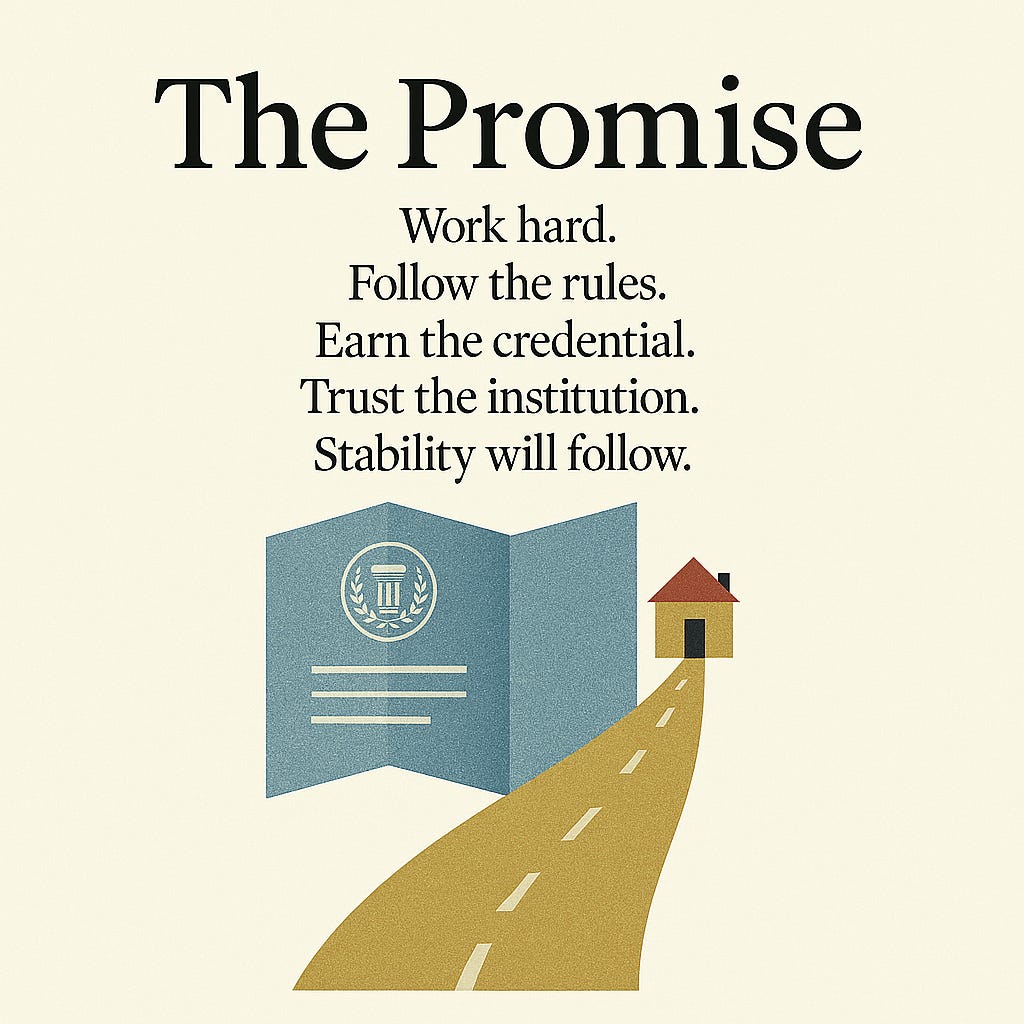
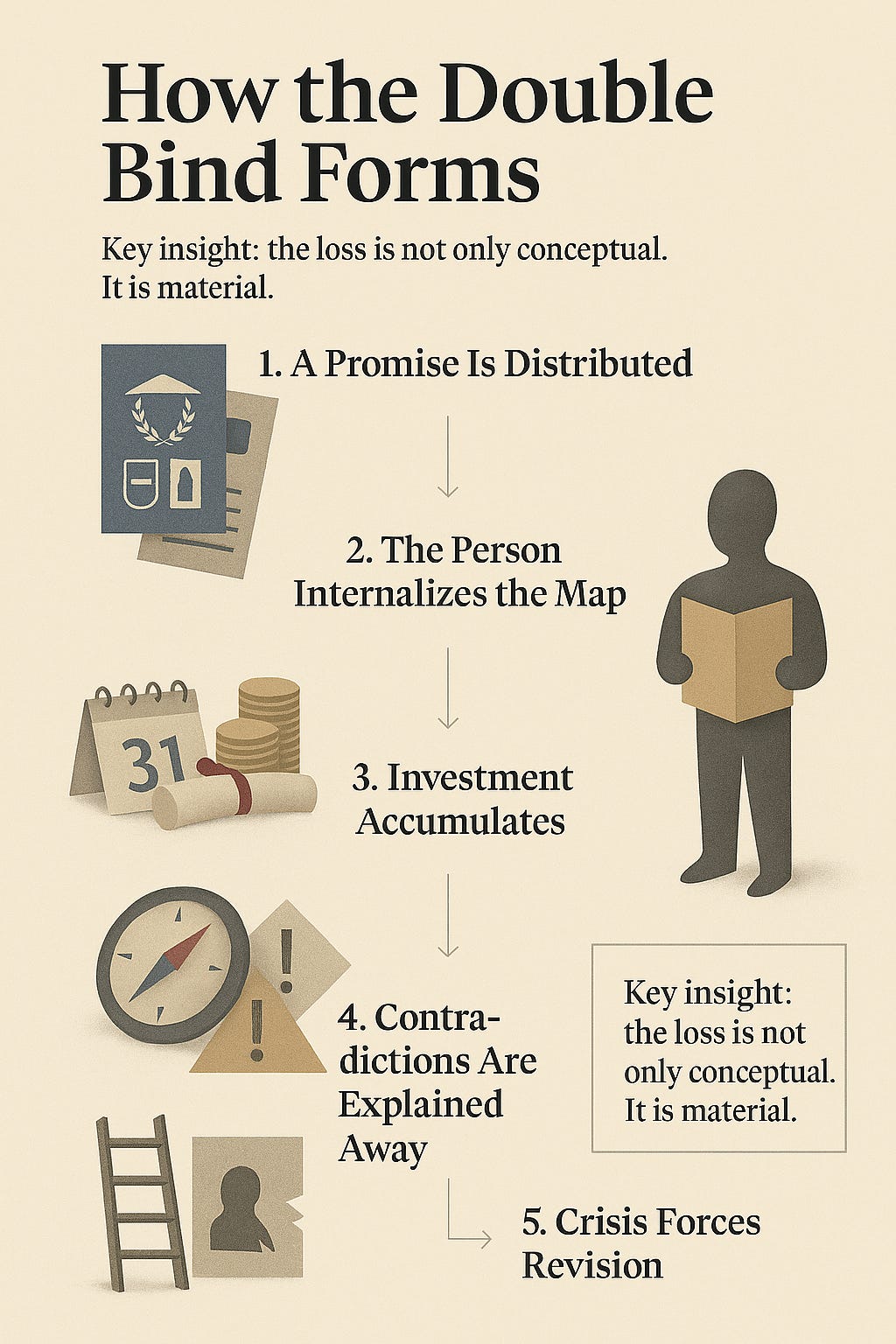
Now consider a different case. Suppose the visitor had been given a brochure, officially produced by the University itself, that described the University as a building — a grand central hall, somewhere, that contained within it all the learning and transformation that a university education provides. Suppose the brochure had been printed in the millions, distributed at every secondary school, endorsed by government agencies, echoed in the testimony of everyone the visitor respected. Suppose, further, that the brochure was not an innocent mistake but a calculated representation — because the University, or the interests that controlled it, benefited from visitors who expected a building, because visitors who understood the institutional nature of what they were entering would make different, more demanding, more structurally aware choices.
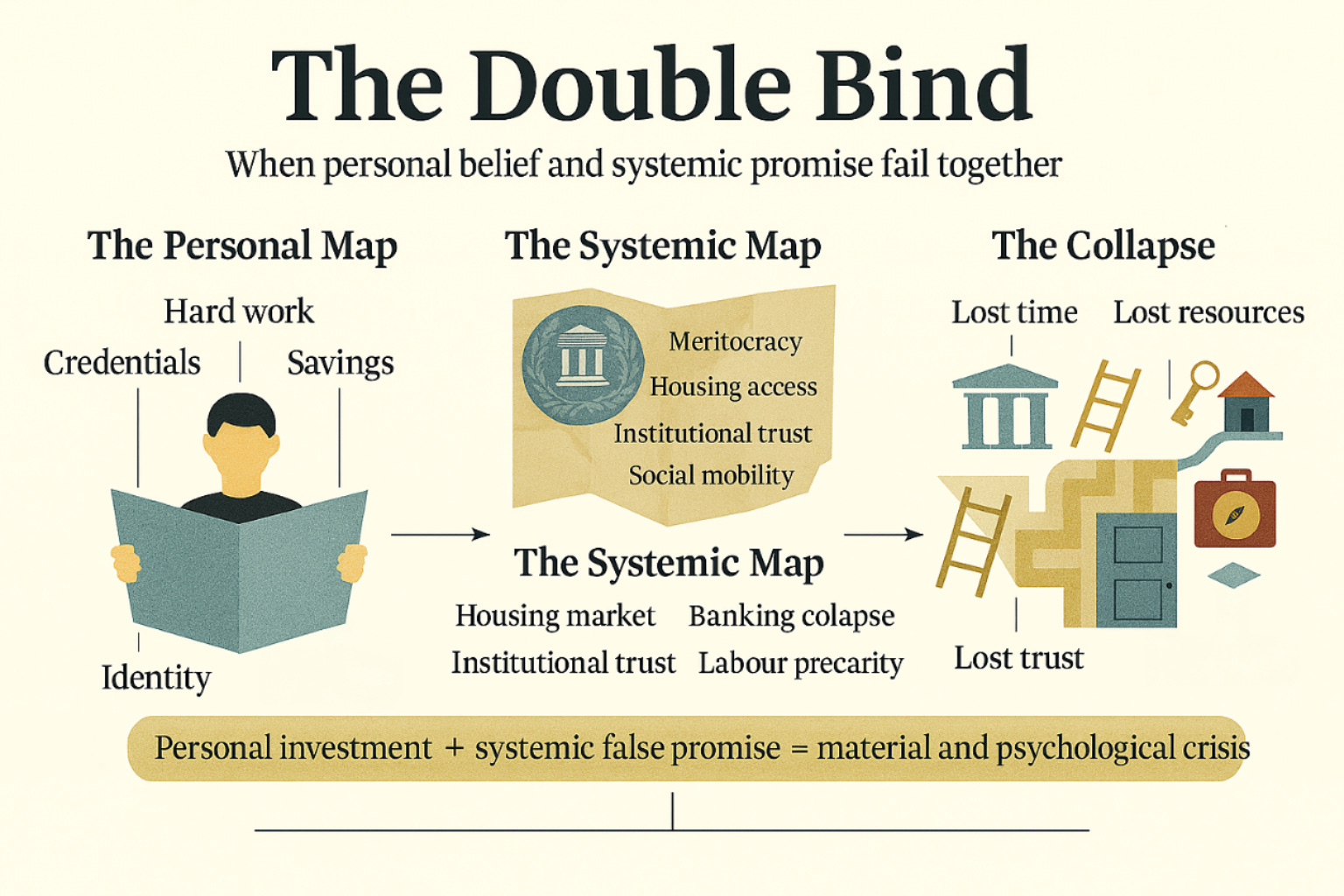
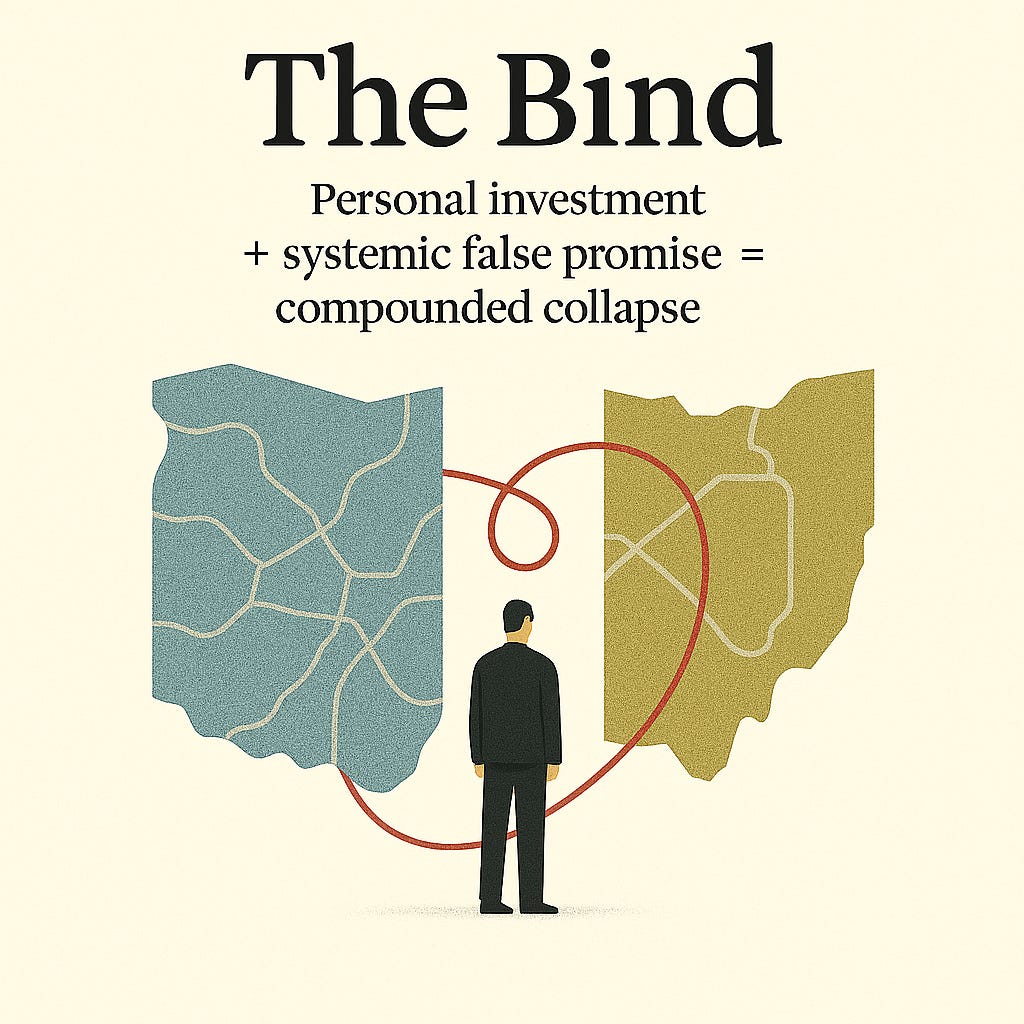
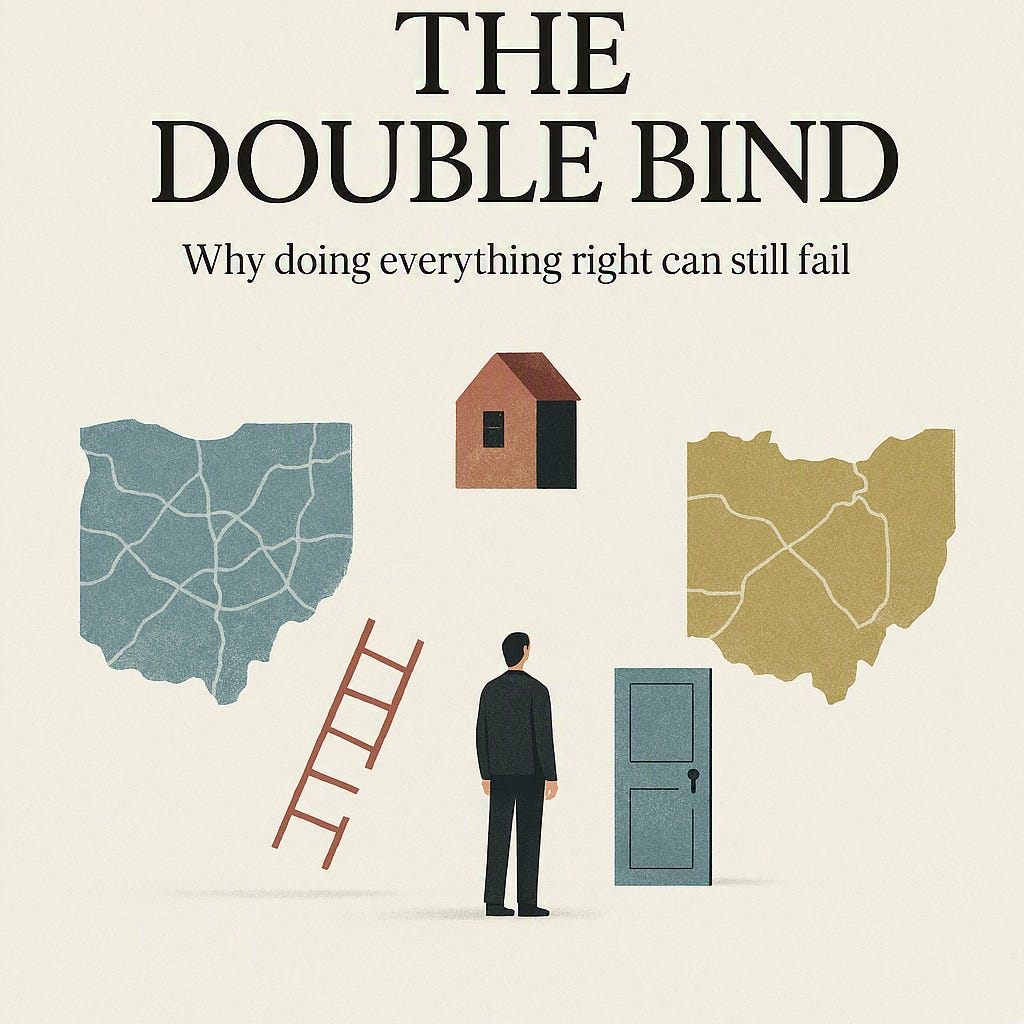
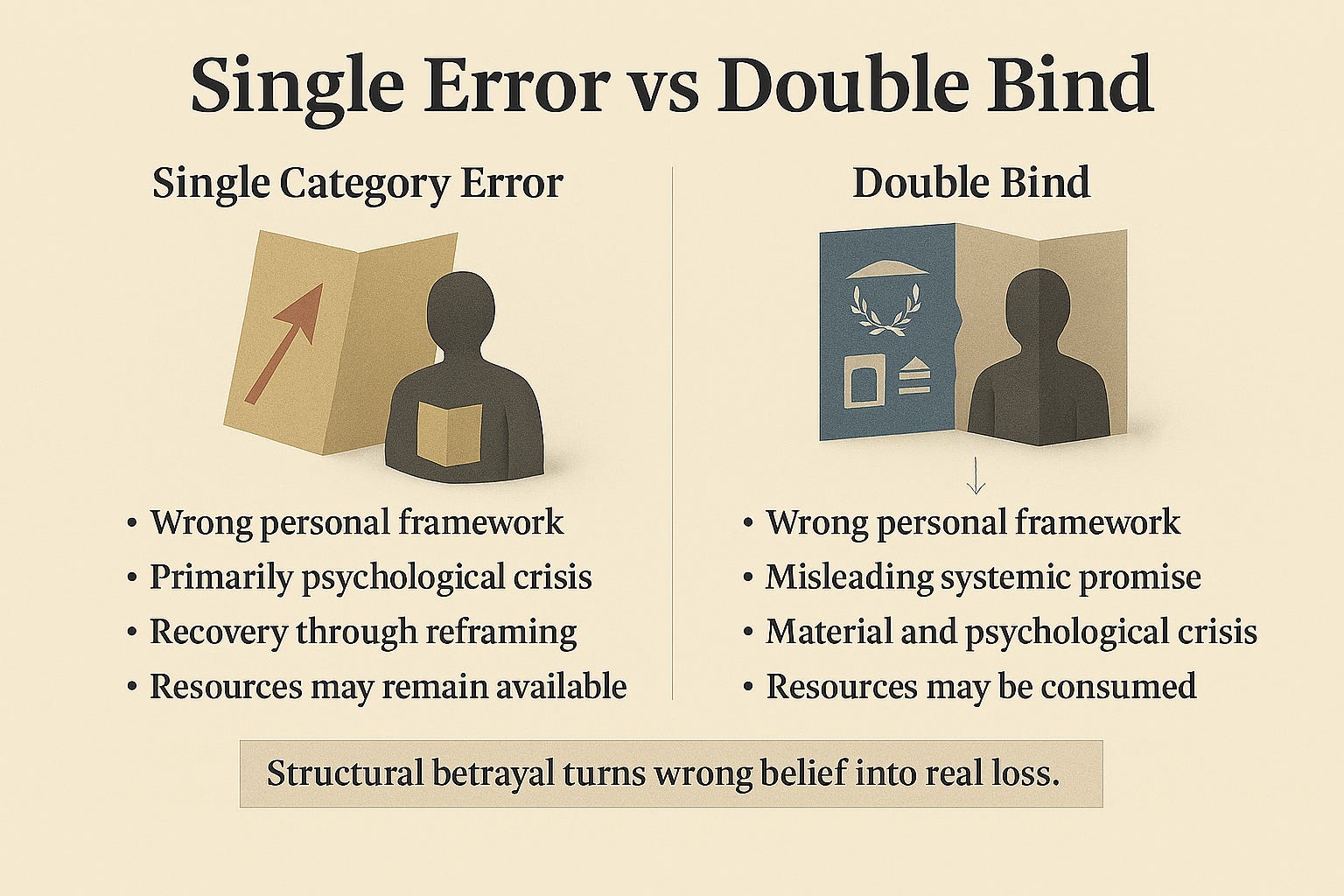
This is the situation of a different kind of category error — one that is not primarily personal but systemic. And when the personal error and the systemic error operate simultaneously, reinforcing and compounding each other, the result is something qualitatively more devastating than either alone. It is a double bind in the precise sense that Gregory Bateson gave the term: a situation structured such that whatever you do within the existing framework of understanding, you cannot win — not because you are not trying hard enough, but because the framework itself has been designed, consciously or structurally, to produce that outcome.
This essay is about the people living inside that double bind. The immigrant who arrived with a genuine belief in the promise and found, years or decades later, that the promise was structurally impossible. The graduate who borrowed and studied and credentialed themselves toward a floor that had been removed. The small business owner who built for decades and then discovered that the structural protections they had been implicitly promised were largely fictional. The young person who tried to access the systems theoretically designed for them and found those systems built for someone else. The merchant whose savings were dissolved by a state that had always been closer to a Ponzi scheme than a banking system. The farmer who needed only to sell what he grew and found armed men at every checkpoint between his field and any buyer.
What joins these cases is not bad luck, though bad luck is part of many of them. What joins them is the convergence of two maps, both wrong — one carried inside, one given from outside — and the compounding devastation that results when neither is questioned until the crisis has already arrived.
I. Two Maps, One Person: The Architecture of the Double Error
The original essay established that category errors operate invisibly, at the level of the map rather than the territory. You cannot see that you’re using the wrong framework because you are navigating by it — and the cognitive immune systems described by Friston’s predictive processing framework, the social enforcement described by Bourdieu’s habitus, and the sunk cost dynamics of accumulated identity investment all conspire to protect the framework against the evidence that would revise it.
What that analysis left implicit is that maps are never purely internal productions. They are social artifacts. The frameworks through which we understand what success means, what work should deliver, what states owe their citizens, what markets reward, what credentials guarantee — these are not invented individually. They are distributed at scale, through institutions, media, education systems, immigration recruitment campaigns, financial product marketing, political discourse, and the testimony of everyone around us who has not yet discovered that the map doesn’t match the territory.
The Italian Marxist Antonio Gramsci, writing from a fascist prison in the 1930s, developed one of the most important concepts in modern social theory: hegemony. His observation was that dominant classes maintain their position not primarily through coercion — though coercion is available — but through the production and dissemination of frameworks of understanding that present the dominant order as natural, inevitable, and universally beneficial. The frameworks are absorbed and reproduced by the people they constrain, not because those people are stupid or weak, but because the frameworks are embedded in every institution through which they understand their world. The worker who believes that wealth flows naturally to those who work hard has internalized a hegemonic framework — one that serves the interests of capital while presenting itself as common sense.
Gramsci called this common sense in a technical sense: the accumulated, unreflective, contradictory set of beliefs through which ordinary people navigate ordinary life. Common sense is not false in everything — it contains fragments of real wisdom and genuine experience. But it is also not politically neutral. It is saturated with the interests of the dominant order, which has invested enormously in its production and maintenance.
The concept of hegemony extends and deepens the account of systemic category errors. The wrong map is not merely distributed — it is manufactured, maintained, and enforced. And because it is presented as common sense rather than ideology, questioning it requires not just individual insight but a form of structural analysis that the map itself makes difficult. The map that tells you hard work produces prosperity also tends to tell you that skepticism about this proposition is laziness, resentment, or the rationalization of failure. The system that produces the category error also produces the defense of the category error against those who experience its consequences.
Pierre Bourdieu’s concept of misrecognition (méconnaissance) captures this at a more granular level. Misrecognition is the process by which structural conditions — the actual determinants of who succeeds and who doesn’t — are systematically mistaken for individual qualities. The child from a privileged background who succeeds in school is seen as intelligent and hardworking; the child from a deprived background who fails is seen as lacking talent or application. The structural advantages of the first and the structural disadvantages of the second are rendered invisible by a framework that attributes outcomes to individual merit. The violence of the structure is real — it determines who eats, who learns, who accumulates — but it is misrecognized as natural sorting by personal quality.
Misrecognition is the social mechanism through which systemic category errors are maintained at the individual level. The person who fails within a system that was structurally unlikely to reward them does not, typically, conclude that the system is wrong. They conclude that they are insufficient. This is not masochism. It is the entirely rational response of a predictive brain operating within a hegemonic framework that attributes structural outcomes to individual causes — and that has far more institutional prestige and social support than any counter-narrative the individual could generate.
The result is a specific and devastating compounding. The personal category error — pursuing the wrong thing for the wrong reasons — is reinforced and deepened by the systemic category error — believing that the system is structured to deliver what it promises. And both are protected against revision by the same mechanisms: cognitive conservatism, social enforcement, and the sunk cost of accumulated investment. The double bind is sealed.
II. The Promised Land That Wasn’t: Reading the Brochure
To understand the specific character of systemic category errors, it helps to examine the promises themselves — not abstractly, but in the specific institutional forms through which they are distributed.
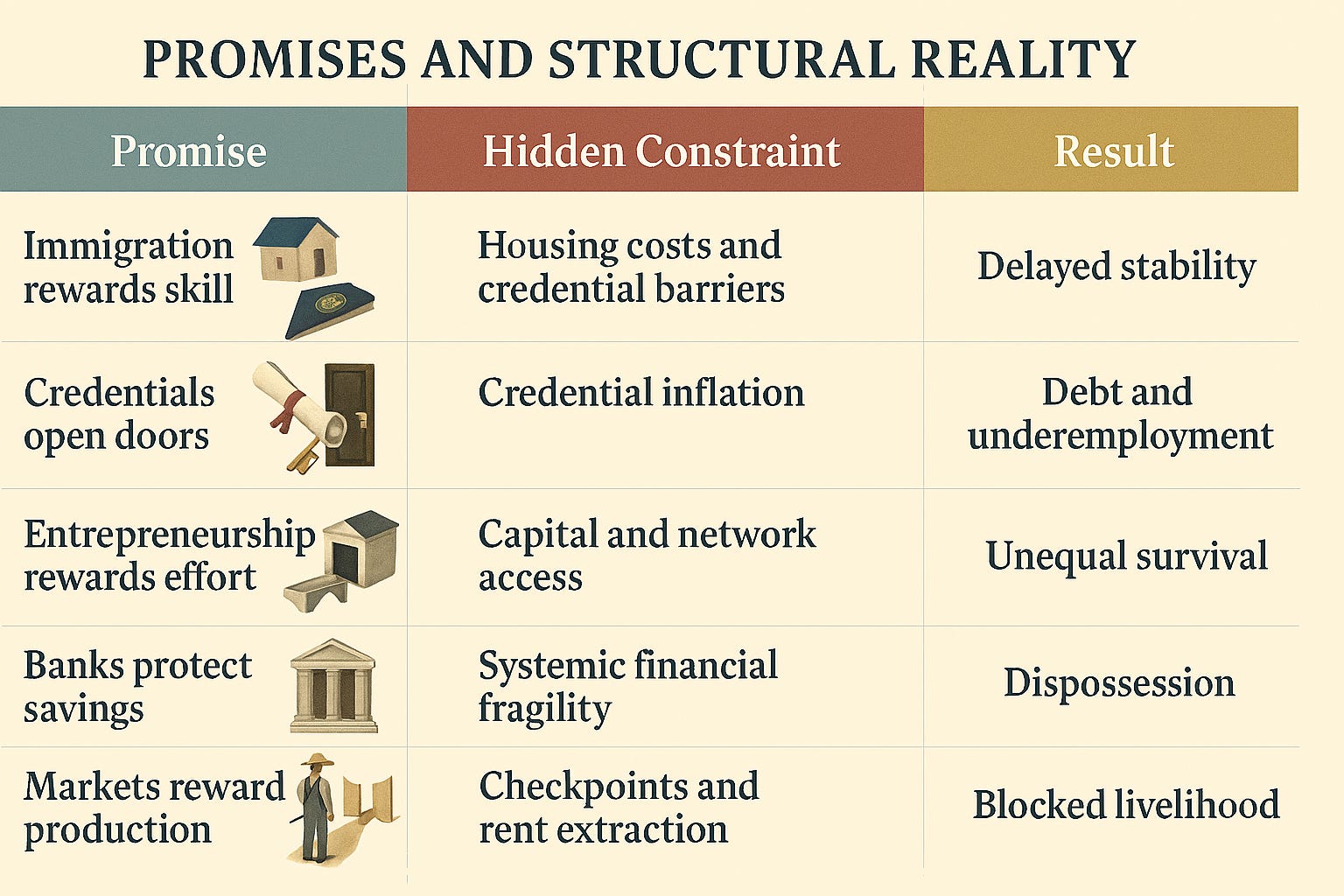
The Immigration Promise. Canada’s immigration recruitment infrastructure is among the most sophisticated in the world. Points-based systems, Express Entry programs, Provincial Nominee Programs, skilled worker categories — the apparatus signals, systematically and officially, that Canada is a place where skills are valued, where effort produces prosperity, and where the middle-class life is accessible to those who are willing to work for it. The promise is not made once. It is repeated in official communications, reinforced by the testimony of established immigrants whose conditions may have been structured differently, echoed by employment agencies and immigration consultants who profit from the transaction, and internalized by people in difficult circumstances who have reason to believe in the better place being described.
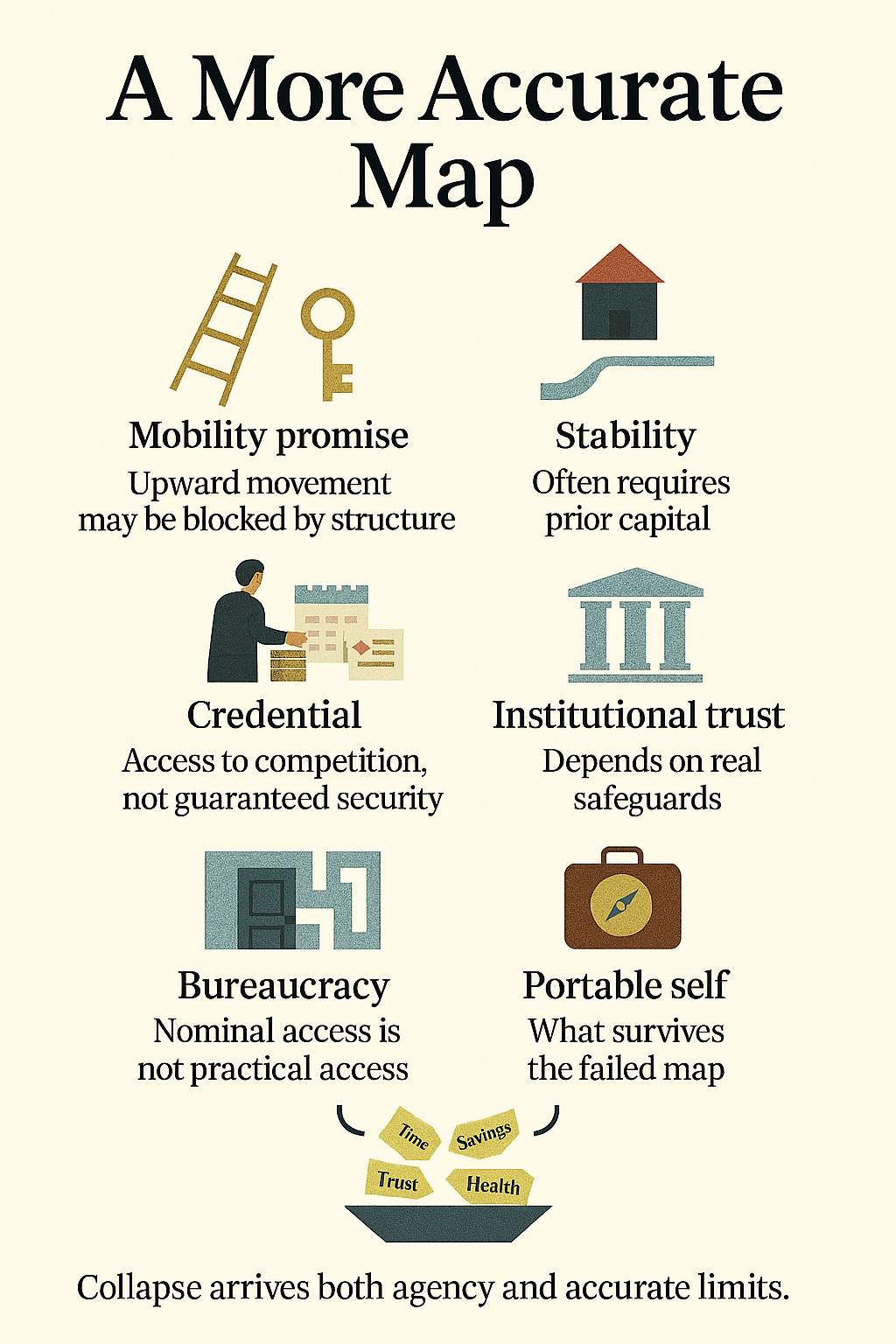
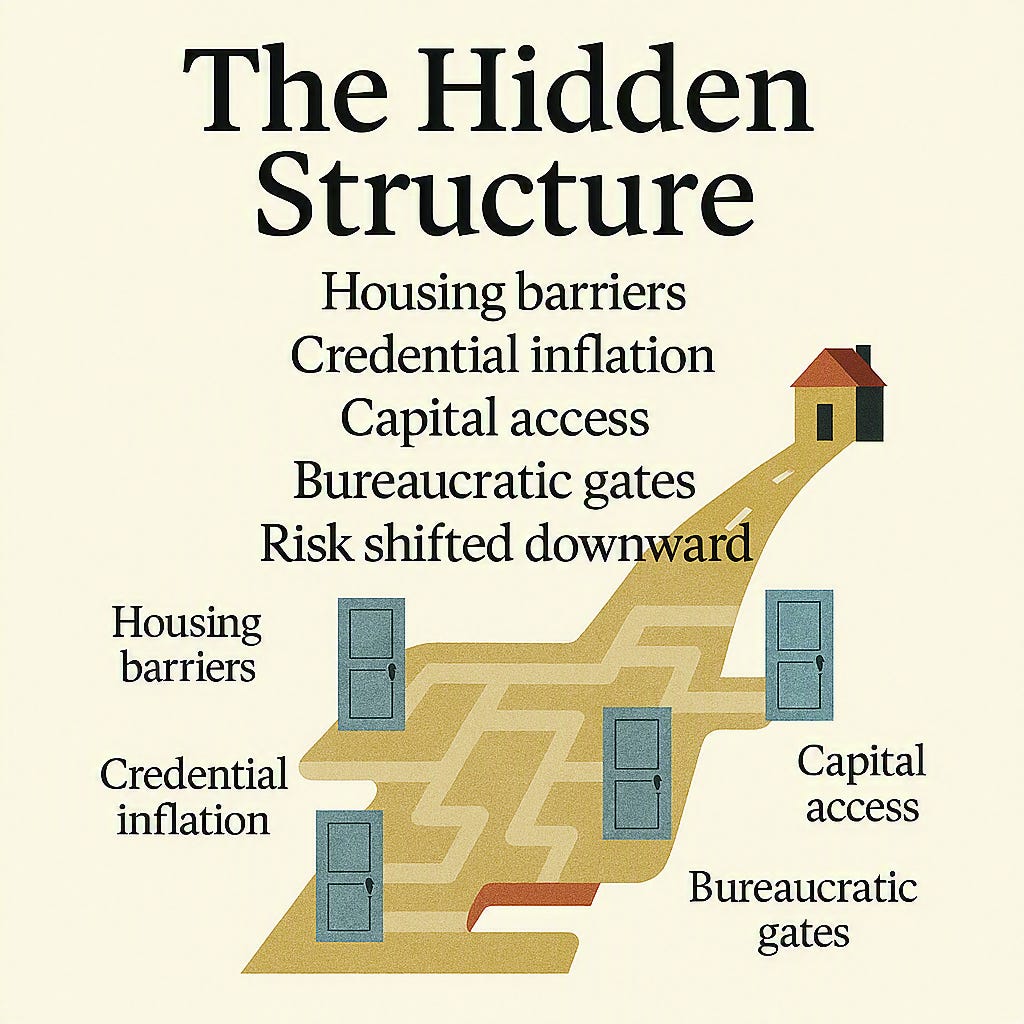
What the brochure does not describe — and what the system has strong institutional incentives not to describe — is the structural reality that the promise increasingly cannot deliver. Canadian housing costs have been transformed by decades of policy choices that treated residential real estate as a wealth-generation asset class rather than a social good, producing price-to-income ratios in major cities that are among the highest in the developed world and that make homeownership structurally inaccessible to people arriving without capital. Credential recognition systems in many professions impose barriers that have less to do with competency verification than with protecting incumbent practitioners from competition. Wage growth in much of the economy has not kept pace with the cost of living for decades. The social services — healthcare, childcare, elder care — that the reputation of Canada as a social democratic country implies are in many cases underfunded to the point that the gap between nominal availability and practical access is enormous.
None of this is hidden in the sense of being classified. It is visible in the data, reported in the journalism, experienced by the people living it. But it is systematically absent from the framework through which the immigration decision is made, and it is actively contradicted by the official discourse of immigration as mutual benefit. The immigrant who arrives believing that sustained effort within the rules will produce the promised outcome is not delusional in any personal sense. They are operating from the map they were given — a map that was produced and distributed by people and institutions who benefit from the immigration flow regardless of whether the individual immigrants ultimately achieve what was promised.
The Entrepreneurial Myth. The cultural narrative of entrepreneurship — the self-made founder, the garage startup, the idea that anyone with sufficient vision and work ethic can build something — is among the most widely distributed and least accurately calibrated frameworks in contemporary economic life. It is distributed through business school curricula, through media coverage that systematically profiles the rare successes while ignoring the far more numerous failures, through government programs with names that imply accessible support and conditions that, in practice, serve primarily those who already have access to professional networks and collateral. In the Canadian context specifically, the venture capital ecosystem is thin compared to American or British equivalents, early-stage capital is exceptionally difficult to raise without existing social proximity to money, and the formal support programs — incubators, accelerators, government grants — function primarily as credential-building exercises for people with existing advantages rather than genuine capital transfer mechanisms for those without them.
The young person who internalizes the entrepreneurial framework — who believes that innovation, hard work, and a good idea are the primary determinants of entrepreneurial success — is making a personal category error. But they are making it because the systemic narrative has systematically misrepresented what entrepreneurial success actually requires. The primary determinant of startup success is not idea quality, work ethic, or even market timing. It is access to the social networks through which capital flows, through which early customers are found, and through which the inevitable early failures are survived. This access is not available on equal terms. It is distributed through existing concentrations of wealth and privilege. The system is not structured as a meritocracy with imperfect execution. It is structured as a network of inherited advantages with meritocratic narrative as cover.
The Credential Promise. The post-war expansion of higher education in Western countries was predicated on a genuine and historically observable correlation: educational credentials were associated with higher lifetime earnings, more stable employment, and social mobility. This correlation was real — in the specific historical conditions of a rapidly expanding economy with genuine skill shortages, where the proportion of the workforce with higher credentials was small enough that credentialed workers captured significant wage premiums.
The systemic category error is the extension of this historical correlation to contemporary conditions where it no longer holds, or holds only weakly, for a growing proportion of graduates. Credential inflation — the process by which credentials that once secured middle-class employment now secure only access to the competition for it — has proceeded at a rate vastly exceeding the economic conditions that justified it. The student who borrowed heavily to obtain a credential in the reasonable belief that the credential would produce the economic return it historically had is not making a primarily personal error. They are making a rational inference from a systematically misleading framework. The framework was wrong not by accident but because it served institutional interests: universities that expand enrollment, governments that privatize the cost of human capital development through student debt, employers who use credentials as cheap screening mechanisms for attributes that the credential doesn’t reliably measure.
The Safety Net Illusion. Perhaps the most consequential gap between systemic promise and structural reality is in the domain of public services. Modern welfare states present themselves — through their formal architectures, their political rhetoric, and their institutional names — as systems designed to ensure that citizens in difficulty can access the support they need to recover and rejoin productive life. The reality, in country after country, is a system designed more precisely to manage and contain the social disruption of poverty than to genuinely enable mobility out of it. Access barriers are real: eligibility requirements that disqualify those with the greatest need, application processes whose complexity itself constitutes a class barrier requiring literacy, stability, and administrative capacity that people in genuine crisis may lack, service levels calibrated to prevent dependency rather than enable recovery, and means-testing mechanisms that punish the accumulation of even modest assets.
The youth leaving a dysfunctional home environment who encounters this system does not find what the social contract promised. They find a system that is functionally designed for people already closer to stability than they are — people who need a temporary bridge, not a structural foundation. The personal category error is the belief that the system means what it says it means. The systemic error is the system’s own self-presentation as something it is not. Both are real. And the compound consequence — the discovery that neither your own efforts nor the system you expected to support them will produce the promised outcome — is categorically more damaging than either alone.
III. The Cases: Stories at the Threshold of Double Collapse
Abstract analysis of category errors has the deficiency of all abstractions: it can be understood without being felt, and what these cases demand is both understanding and feeling, because the feeling is part of the data. The suffering is not incidental to the analysis. It is diagnostic.
Consider what actually happens to the immigrant who has lived the promise for fifteen years and finally cannot sustain the rationalization.
She arrived with skills that were valued in her origin country and theoretically valued in her destination. She worked — this is not in question — with a consistency and dedication that would have been rewarded if the framework had been accurate. She paid taxes into a system she expected to protect her. She followed the rules because she had been told that following the rules was the mechanism of the outcome she sought. For a long time, the feedback loop reinforced the framework: she was employed, she was incrementally advancing, she was not visibly failing. The anomalies — the credential that was not recognized, the ceiling above which her accent made advancement difficult, the housing market that receded before her even as she saved — were processed as temporary obstacles rather than structural features. Her predictive brain protected the framework. Her habitus, formed in a social world that valued the immigration narrative, supported it. Her sunk cost of identity — the years, the choices, the sacrifices, the story she had told her family — made revision increasingly expensive.
And then the gap becomes too large. The calculation that kept the framework intact — I am not there yet, but I will be — stops closing. She is in her forties. The home is not achievable. The retirement is not funded. The children she hoped to give opportunities are in the same system that failed her. The crisis that follows is not merely the recognition that she made wrong choices. It is the more devastating recognition that she made the right choices inside a wrong system — that her effort was real and her reward was structurally withheld.
This is a qualitatively different crisis from the one the original essay described. The midlife executive who discovers that status was never going to produce meaning can, in principle, revise their personal framework and redirect their energies. The framework they need to revise is primarily their own. But the immigrant who discovers that the middle-class life she was promised was a structural impossibility must revise not only her personal framework but her understanding of the system she is embedded in — and she must do this while living with the consequences of the original error, in a social environment that still uses that error’s framework as common sense.
The post-COVID small business owner faces an adjacent but distinct version of the same double structure. The personal category error, in many cases, was what we might call the identity fusion error: the conflation of the self with the business, such that the business became not merely a livelihood but a person’s entire ontology — their social role, their daily structure, their sense of competence and purpose, their story of who they are. This is a recognizable variant of the category errors the original essay described: treating identity as a noun rather than a verb, locating meaning in an external structure rather than in the ongoing activity of constructing it.
But the systemic error was equally real and equally concealed. The small business existed within an implicit social contract: if you build something that employs people, pays taxes, and serves customers, the institutional environment will be maintained in ways that give that enterprise a reasonable chance of survival. The pandemic revealed that this contract was fictional in crucial ways. The government programs that appeared during the crisis were calibrated to the interests of large enterprises and financial systems, not the two-decade investment of a person who employed six people and owned their equipment. The bankruptcy system was not designed to enable genuine fresh starts — it was designed primarily to protect creditors. The labor market that followed valued credentials and employment history in ways that systematically discounted entrepreneurial experience. At fifty-two, with a business destroyed and debt accumulated, the person who enters the labor market discovers that the system they had been a part of does not recognize what they built as the kind of capital that transfers into employability.
The compounding effect is visible in the arithmetic of their situation. The years that should have been their peak earning and saving years were spent building something that is now gone. The financial cushion that would have made recovery possible was consumed in the final effort to save the business. The identity that would have provided psychological stability through transition was fused with what collapsed. And the systemic framework — which should have provided either better institutional support or honest information about the absence of such support — provided neither.
The young person who believed in credentials faces a more particular version of the systemic error: the credential is a positional good, and its value is therefore relative rather than absolute. This is a point the economist Robert Frank has made about many status goods: their value is determined not by their intrinsic properties but by their position in a hierarchy. When credentials were scarce and the economy was expanding, they functioned as genuine tickets to prosperity. When credentials became mass-market — as governments and universities, for excellent institutional reasons, encouraged — their positional value was diluted in ways that the individuals making the decision to pursue them could not observe in advance. The person who borrowed eighty thousand dollars for a credential that, in their parents’ generation, would have secured a middle-class life has not made a stupid mistake. They have made a rational inference from a framework that was accurate in a different historical moment and has been systematically presented as still accurate despite the structural changes that made it false.
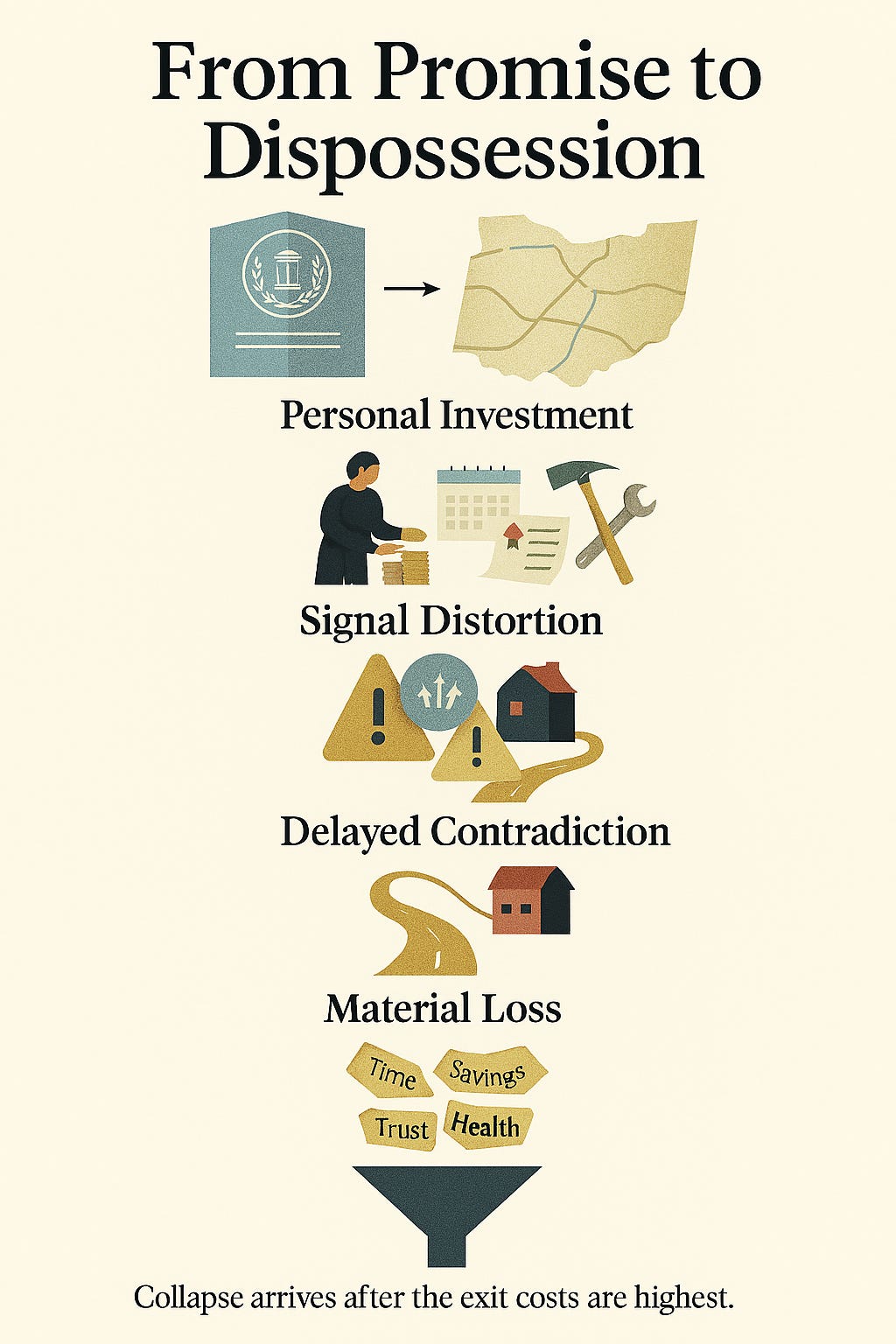
What makes these cases converge on a single analytic category is not their specific content but their shared structure: a framework was offered — by institutions, by official discourse, by the testimony of people around them — that described the system as capable of delivering what it promised, provided the individual did what was asked. The individual, operating with a predictive brain that protects frameworks from revision and a habitus that treats socially shared beliefs as natural, invested. And the investment — years, debt, identity, opportunity cost — accumulated on the basis of a false map.
The Lebanese merchant who watched the banking system freeze and his life savings dissolve through currency devaluation had operated, for decades, within the framework that formal banking systems protect deposited capital. This framework is not arbitrary or naive. It reflects the actual functioning of banking systems in most of the world for most of the past century. His personal error was the failure to see the specific structural fragility of the Lebanese banking system — a Ponzi-like structure dependent on perpetual inflows, known to economists and analysts, invisible to the depositor whose interface with it was a branch office, a passbook, and the reassuring institutional apparatus of normality. The systemic error was the system’s own presentation of itself as normal when it was not. Both errors were real. And neither alone would have produced the outcome that both together did.
The Yemeni farmer who must pay armed factions at checkpoints to access markets for his harvest is living inside the most extreme version of this double structure. His personal framework — that market participation is the mechanism of livelihood — is not wrong in any ordinary sense. Markets are the mechanism of livelihood in most human contexts. His systemic error is the assumption that the political economy he is embedded in is structured to permit that mechanism to function. It is not. The territory between his field and any buyer has been converted, by the collapse of state authority and the proliferation of armed actors, into a rent-extraction system in which the surplus of every transaction is captured by whoever controls the relevant checkpoint. He cannot produce his way out of this. He cannot work his way out. The framework within which his personal effort could produce outcomes has been structurally dismantled. No amount of individual insight about his own category errors will restore it.
IV. Where Personal and Social Errors Converge
The two errors — personal and systemic — share a deep structural identity that explains why they are so difficult to separate, so mutually reinforcing, and so resistant to correction independently.
Both are maintained by the same cognitive mechanisms. The predictive brain protects the systemic framework just as it protects the personal one: anomalies are explained away, disconfirming evidence is reinterpreted, the protective mechanisms of rationalization and selective attention operate on socially distributed beliefs just as on individually held ones. When a credential fails to deliver the promised return, the first response — personally and socially — is to attribute the failure to individual execution rather than systemic structure. The graduate needs to develop more skills, build more networks, apply more persistently. The framework — credentials produce economic security — is not questioned. The individual is.
Both are embedded in social structures that actively enforce them. The habitus — Bourdieu’s internalized social world — enforces personal category errors by making deviation from socially sanctioned frameworks feel like identity loss. The hegemonic discourse — Gramsci’s common sense — enforces systemic category errors by making structural critique feel like excuse-making or resentment. The person who begins to question whether the immigration promise was always going to be fulfilled not only risks their own framework but risks their social belonging: their community of fellow immigrants is often invested in the framework that justified all their sacrifices. Questioning the framework can feel like betraying the sacrifices of everyone around you.
Both exploit the sunk cost dynamic at scale. The personal sunk cost — the years, the identity investment, the choices made on the basis of the framework — is compounded by the systemic sunk cost. The entire social world has organized itself around the premise that the framework is true: governments have built their legitimacy on the promise that hard work produces prosperity, that credentials open doors, that the system is fair for those who follow its rules. The social cost of admitting that the framework is fundamentally wrong — for the governments that depend on the promise, for the institutions that profit from it, for the individuals who have made their entire self-concept around succeeding within it — is enormous. The framework is protected not just by individual cognitive conservatism but by the institutional interests of every actor who benefits from its maintenance.
Both produce what we might call feedback corruption: the distortion of the signals that should indicate the error’s presence. The student accumulating debt without economic return receives signals that reinforce the framework — university completion, credential acquisition, graduation ceremonies — while the systemic signal that the framework is broken (the actual labor market return) arrives only years later and is attributed to personal inadequacy rather than structural mismatch. The immigrant receives signals of progress — employment, language acquisition, social integration — that reinforce the framework while the structural signal that the promised outcome is not achievable accumulates slowly, below the threshold of daily experience, until it suddenly cannot be explained away.
And both are corrected — when they are corrected — through the same mechanism: crisis. The Kuhnian paradigm shift, the Bakian avalanche, the Van Gennepian liminal state — these operate at both the personal and the social level. The crisis that occurs when the accumulated gap between the framework’s promises and reality’s deliveries becomes too large to manage is structurally identical whether the framework is primarily personal or primarily systemic. This is why the personal and systemic crises so often arrive together: the systemic anomalies become undeniable at approximately the same time that the personal accumulated investment reaches the threshold at which revision becomes unavoidable.
V. Where They Diverge: The Specific Character of Structural Betrayal
But here is where the double bind becomes genuinely different from the single error the original essay described — and where the standard account of crisis and recovery becomes insufficient.
When the category error is primarily personal, the crisis offers a specific kind of liberation. The executive who discovers that status was never going to produce meaning can, in principle, redirect. The map was wrong, but the territory is still there, and the territory — meaning, genuine connection, engaged work — is still accessible. The work of recovery is psychological and developmental: Kegan’s transition to the self-authoring mind, the liminal passage through which a more accurate and more internally generated framework emerges. Hard, disorienting, but within the individual’s capacity to navigate with appropriate support.
When the structural error is real — when the system was not, in fact, going to deliver what it promised — the crisis offers a different, more ambiguous kind of clarity. The map was wrong. But so was the territory as presented. The hard work really was unlikely to produce the middle-class life. The credential really was overvalued relative to its labor market return. The banking system really was structured to fail. The farms really are surrounded by armed checkpoints. No amount of personal psychological development, no transition to a higher order of mind, no more accurate personal framework restores the fifteen years of savings dissolved by currency collapse or the two decades of business investment wiped by a pandemic and inadequate institutional support.
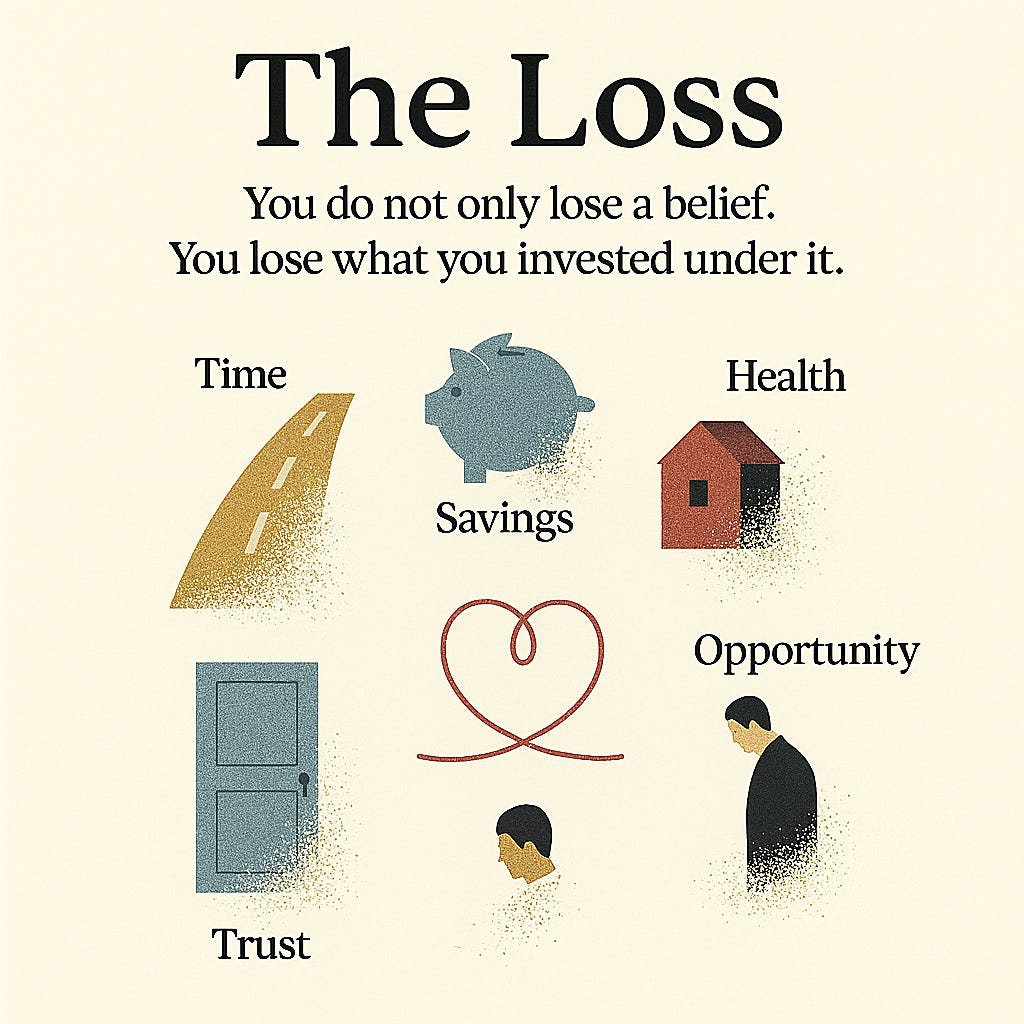
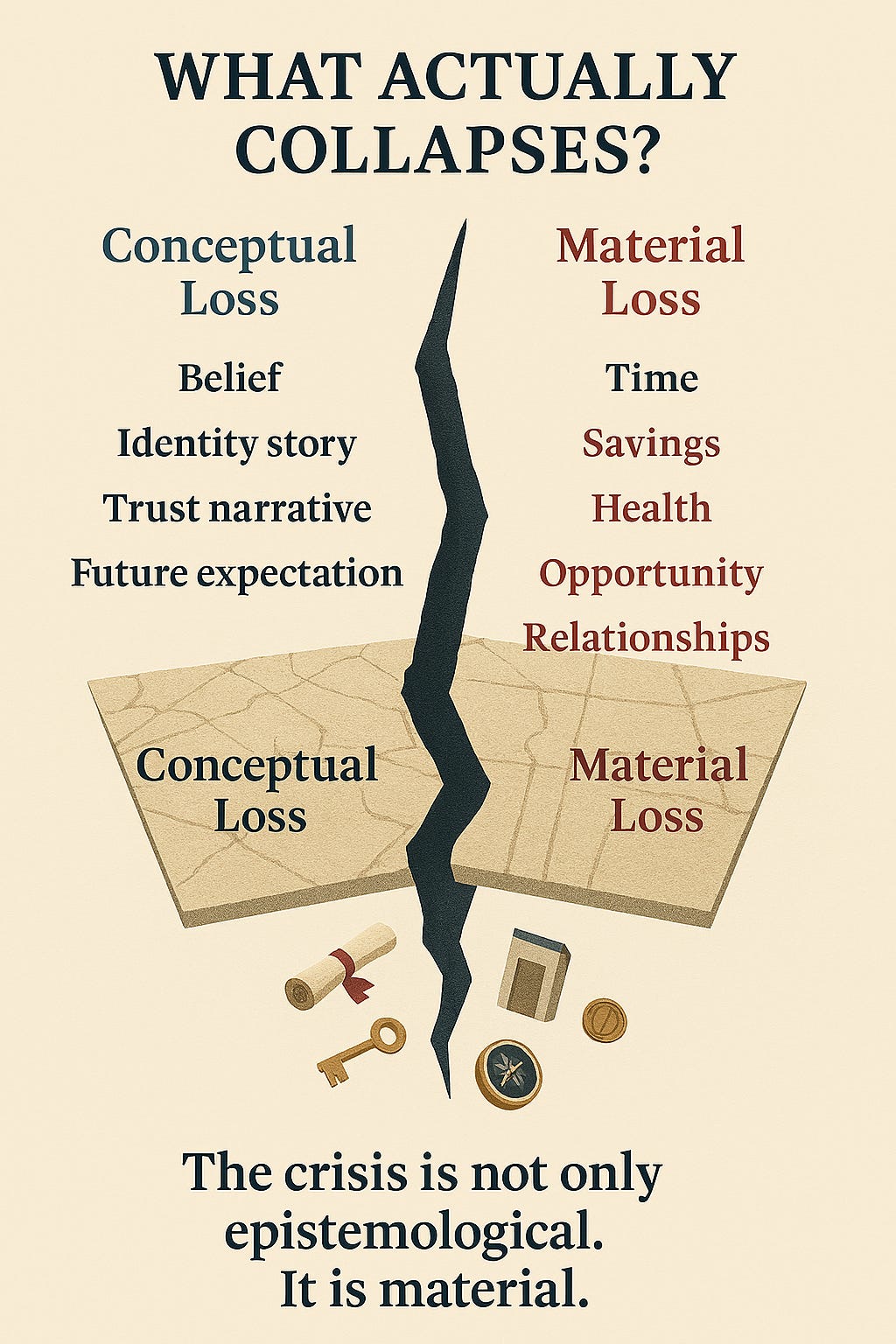
This is the specific character of structural betrayal: it does not merely redirect you, as a purely personal crisis does. It dispossesses you. The loss is not merely of a mistaken framework but of the actual resources — time, money, opportunity, health, relationships — that were invested on the basis of that framework. And because the loss is real, not merely conceptual, the recovery requires not just a new map but actual resources to rebuild with — which are often exactly what the crisis has consumed.
The sociologist Charles Tilly, in his work on Durable Inequality, identified what he called opportunity hoarding as one of the primary mechanisms through which inequality is reproduced across generations: the tendency of advantaged groups to monopolize access to valued resources by constructing categorical distinctions that exclude others. The credential, the professional association, the social network that provides access to capital — these are mechanisms of opportunity hoarding. Their presentation as meritocratic is the ideological cover for what is structurally a system of categorical exclusion. The person who has spent a decade pursuing credentials that were supposed to open these doors, only to find that the doors open primarily from the inside, has not made an individual error of effort. They have encountered the structural reality that was always behind the meritocratic presentation.
This divergence has a crucial practical implication. When the error is primarily personal, the corrective work is primarily internal: revision of the framework, development of a more accurate and more generative way of understanding what you are building and why. When the error is also structural, the corrective work must include something the original essay’s framework does not fully address: accurate structural diagnosis. You must understand not only what you were pursuing and why, but what the system is actually structured to deliver — and for whom.
Guy Standing’s work on the precariat is useful here. Standing identifies a new class formation — the precariat — defined not by its relationship to capital ownership or formal employment category but by its relationship to labor market instability, benefits insecurity, and the experience of working lives that combine multiple forms of insecure employment without the protections historically associated with stable employment. His key observation: the precariat is not a transitional condition that can be individually escaped through greater effort or better choices. It is a structural position within an economy that has been deliberately reorganized to transfer risk from capital to labor. The individual who experiences precarity as a personal failure — who believes that more credentials, more networking, more hustle will produce the stability the system promises — is making a category error of exactly the kind we have been examining. But the error is not primarily theirs. It was given to them by a system that benefits from their belief in it.
VI. The Arithmetic of Compounding: When Both Errors Run Simultaneously
Per Bak’s sandpile reaches criticality through the accumulated logic of grain after grain after grain, each individually negligible, until the structure is one grain from avalanche. The double category error — personal and systemic — follows the same logic, but with two different accumulation dynamics operating simultaneously, reinforcing each other.
The personal error accumulates through the mechanisms described in the original essay: predictive brain conservatism, habitual enforcement, sunk cost compounding. The systemic error accumulates through those mechanisms operating at the social level — plus the additional dynamic that systemic errors are protected by institutional interest. Banks, universities, governments, immigration authorities, real estate markets, and labor markets all have structural interests in the continuation of the frameworks that justify their positions, revenues, and legitimacy. They are not merely passive carriers of false frameworks. They are active producers and maintainers of them.
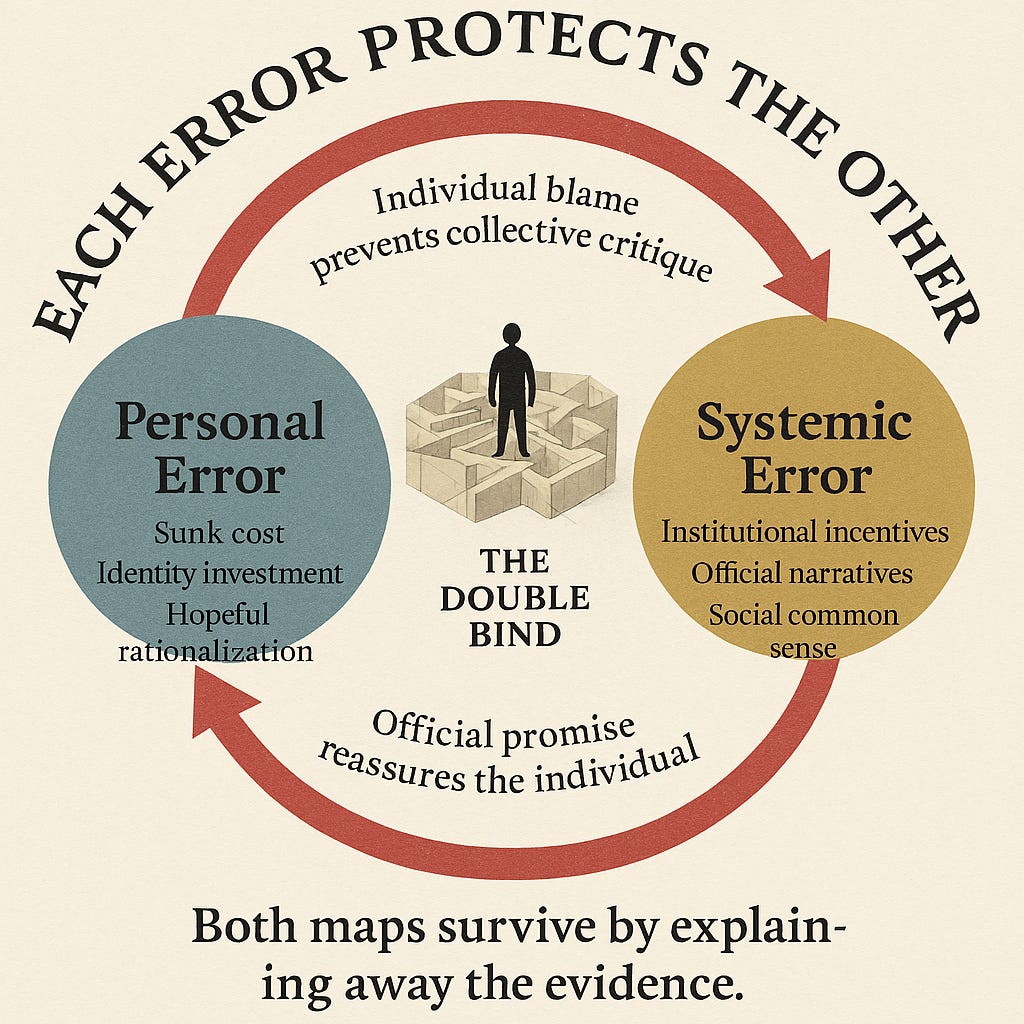
When both dynamics run simultaneously in the same person’s life, the arithmetic of compounding is not additive. It is multiplicative. The personal error would, eventually, be self-correcting: the anomalies accumulate, the framework cracks, the crisis arrives, and however painful, a more accurate framework becomes available. The systemic error would, eventually, be collectively corrected: the anomalies accumulate across enough people, the political conditions shift, the institutional framework is revised or discredited. But when they run together, in the same person at the same time, each error protects the other from correction. The personal framework is maintained partly by the systemic one — the immigrant who begins to doubt the immigration narrative can be reassured by official statistics, by government communications, by the testimony of community members who are invested in the same framework. The systemic framework is maintained partly by the personal one — as long as enough individuals attribute structural outcomes to personal inadequacy, the collective critique necessary for systemic revision cannot form.
This is the double bind at its most precise: each error functions as the other’s immune system.
Consider the specific case of the middle-aged worker who needs retraining but lacks the social support structures to access it. The personal error may involve an understanding of work as stable, of skills as durable assets, of employer loyalty as a reasonable long-term strategy — frameworks that were accurate in the specific historical conditions of the post-war labor market and have become progressively less accurate as the labor market has been reorganized around flexibility, contract employment, and the erosion of firm-specific skill investment. The systemic error is the presentation of lifelong learning and retraining programs as genuinely accessible routes to labor market reinvention — when the actual programs available are designed primarily for people who already have stability, savings, childcare, housing security, and cognitive bandwidth sufficient to take on significant learning loads while managing ongoing financial pressure.
The double compounding is visible in the gap between the program’s nominal availability and its practical accessibility. The worker is told the program exists. They believe, personally, that if they can just access the training, they can rebuild. Both the personal and the systemic framework are intact. What is not intact is the actual pathway between the worker’s current situation and the program’s genuine use — a pathway blocked by prerequisites (stability), costs (time and money), and the fundamental mismatch between a program designed for the relatively stable and the situation of someone who is genuinely precarious.
The Lebanese merchant, watching the currency dissolve, is experiencing the most acute version of the multiplicative compounding. His personal error was the reasonable inference that institutional banking protects deposited assets. His systemic error was the failure to see — and the system’s active obstruction of seeing — that the Lebanese banking system was structured around a carry-trade mechanism dependent on perpetually high interest rates and perpetual inflows of diaspora remittances, a structure that economists had been warning about for years. Both errors were individually understandable and together devastating. And critically: when the crisis arrives, it does not arrive with the clarity of a personal paradigm shift. It arrives as dispossession — as the literal removal of the resources that would have funded any recovery.
VII. The Invisible Damage: What the Double Crisis Does That the Single Crisis Does Not
The original essay described the crisis that corrects a personal category error as an epistemological event — a forced update to a framework that normal cognitive processes were systematically protecting against revision. This framing is accurate and important: the crisis is not pathological but necessary, the liminal state is not a breakdown but a passage, and what emerges on the other side — when the passage is navigated rather than fled — is a more capacious and more accurate framework.
But this account of the crisis assumes something that the double error undermines: that the primary loss in the crisis is conceptual. That what is lost is a framework, and that frameworks, however painful to revise, can be revised without losing the actual materials of a life.
When the structural error is also real, the crisis is not primarily epistemological. It is also material. The fifteen years of savings dissolved by currency collapse cannot be reconceptualized into existence. The two decades of business investment wiped by pandemic and inadequate institutional support cannot be reframed as a learning experience that preserves the actual capital invested. The years of loan repayment on a credential that did not produce the promised return cannot be recovered by a shift in developmental order of mind. The physical and psychological health costs of a decade of precarious work, sustained by the belief that stability was just around the corner, cannot be simply reorganized once the framework is revised.
This is the specific wound of the structural betrayal: it is not just that the map was wrong. It is that you walked the territory the map described, consuming real resources — time, health, money, relationships — in the walking. The crisis reveals not just a framework to be revised but a loss to be mourned, material as well as conceptual, that cannot be addressed by epistemological tools alone.
D.W. Winnicott’s false self, as the original essay described, begins to crack in midlife when external achievements can no longer serve as a horizon. But Winnicott’s account assumes that the crack reveals, underneath, a genuine self capable of insisting on its existence — that there is something authentic to recover once the false structure dissolves. In the double error, the crack reveals not just a false framework but the depleted resources of a person who spent their peak years building in the wrong direction on the wrong map given to them by a system that benefited from their misdirection. The genuine self may be there. But the material conditions for its expression — financial stability, health, time, social support — may have been consumed in the service of the false one.
This is why the compounding of personal and structural category errors produces something qualitatively different from either alone: not just the loss of a direction but the loss of the resources that direction would have required, the loss of the years that were consumed in the wrong pursuit, and frequently the loss of the health, relationships, and psychological reserves that a different trajectory might have preserved.
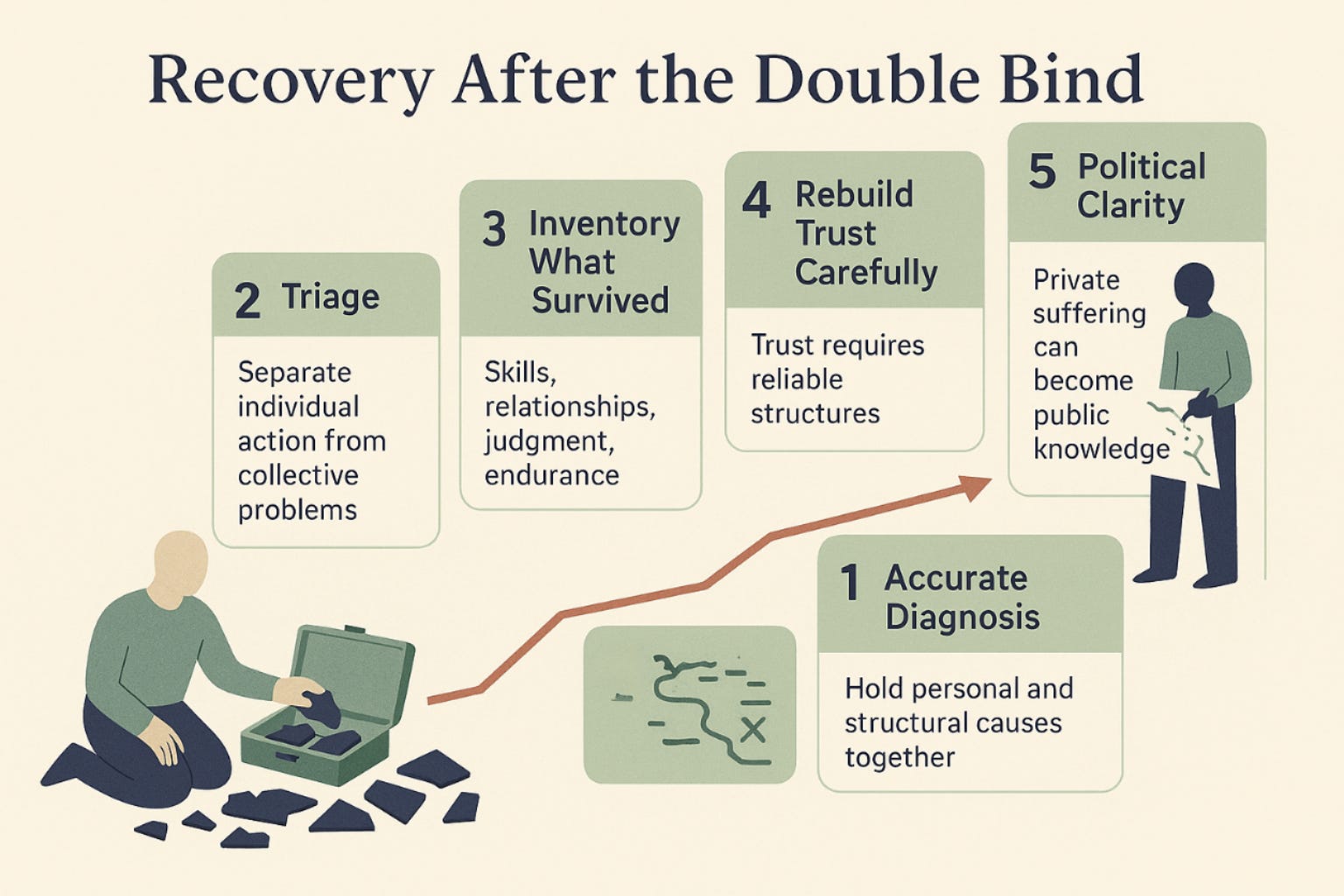
VIII. Recovery When Both Errors Are Real: The Specific Demands of the Double Crisis
Recovery from a personal category error, as the original essay described, involves recognizing the crisis as an epistemological event, staying in the liminal state long enough for a more accurate framework to form, and emerging with a more capacious and more internally generated understanding of what you are building and why. This is demanding work. It is also, in principle, fully available to the individual: the resources required are primarily psychological and developmental, and while they are not easy to access, they are not externally withheld.
Recovery from a double category error — personal and structural simultaneously — requires something more, and something different, in at least five specific dimensions.
First: the accurate diagnosis, without the available consolations. Recovery from a purely personal crisis can be partially consoled by the recognition that the error was your own — that you had agency in the framework you inhabited, however socially inherited, and that therefore you have agency in the framework you construct going forward. This consolation is real. But when the structural error is also genuine, this consolation is only partial, and grasping it too completely is its own kind of error. The immigrant who concludes that their precarious situation results entirely from personal framework failure, and therefore that the solution is entirely personal framework revision, has not yet completed the accurate diagnosis. Part of what happened to them was structural — was done to them, not merely by them — and the failure to acknowledge that structural reality produces a distorted recovery that is likely to reproduce the error in new form. The accurate diagnosis holds both: yes, there were personal category errors in how the framework was adopted and maintained; and yes, the framework itself was produced and maintained by a system that had institutional interests in its maintenance that the individual could not easily see.
This is genuinely difficult. The personal error is easier to acknowledge — it avoids the vertigo of structural critique and maintains a sense of agency. The structural error is easier to acknowledge — it distributes responsibility outward and avoids the self-accusation of having been fooled. The accurate diagnosis requires holding both simultaneously, which is cognitively and emotionally demanding, and which places the person in the precise position of recognizing that they are embedded in a system they cannot individually change while also being responsible for the choices they made within it.
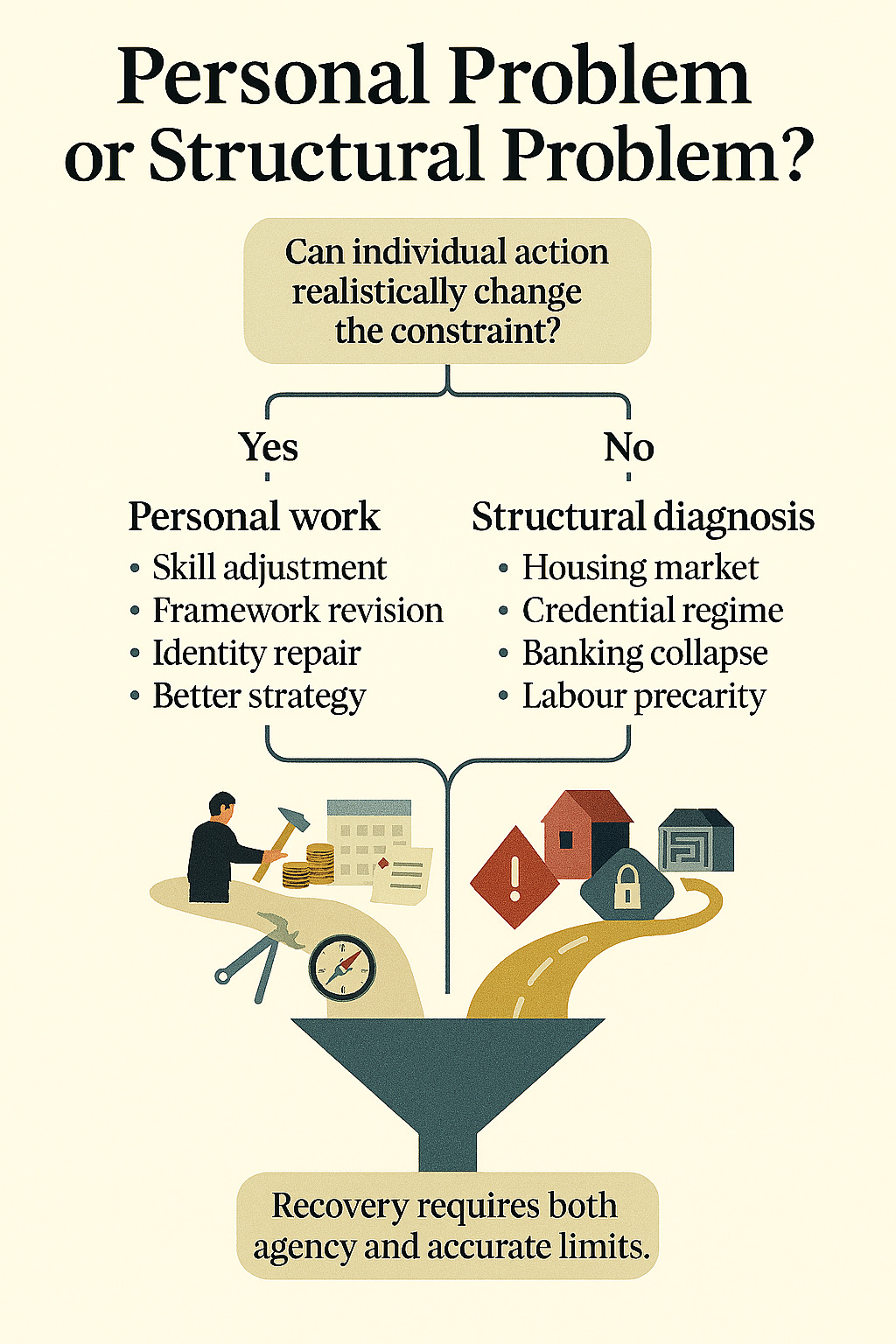
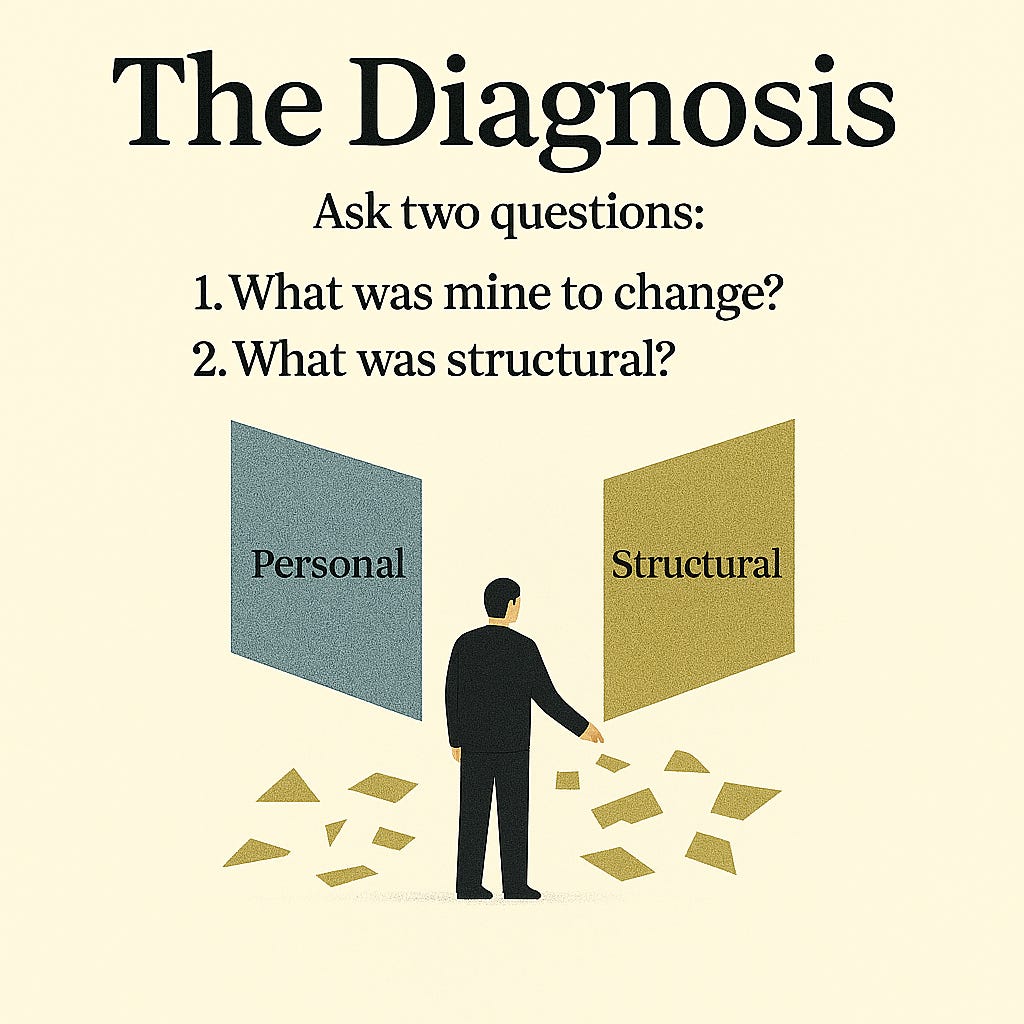
Second: triage between what can be changed individually and what requires structural solutions. Not all consequences of the double error are equally amenable to individual response. Some — the personal framework, the internal understanding of what you are building and why, the quality of your present engagement with what is available — are genuinely within the individual’s capacity to address regardless of structural conditions. Others — the housing market, the credential valuation system, the political economy that governs labor market outcomes, the banking system’s structural design — are not individually addressable and should not be treated as such. Treating structural problems as individual problems, and therefore attempting to solve them through individual effort, produces the exhausting and futile dynamic of people working harder within systems that are not structured to reward their efforts — which is precisely the dynamic the double error created in the first place.
Triage is the capacity to distinguish between these. It is not a simple skill. The social pressure to attribute structural outcomes to individual causes — Bourdieu’s misrecognition — pushes toward treating everything as individually addressable. The opposite error — attributing all difficulty to structural causes and therefore absolving oneself of any responsibility for individual response — is equally disabling. Accurate triage requires exactly the kind of structural analysis that the frameworks both personal and systemic were designed to make difficult: the capacity to ask, about each constraint you face, whether this is a feature of my approach or a feature of the system I am embedded in, and to answer that question honestly regardless of the consolations available in either direction.
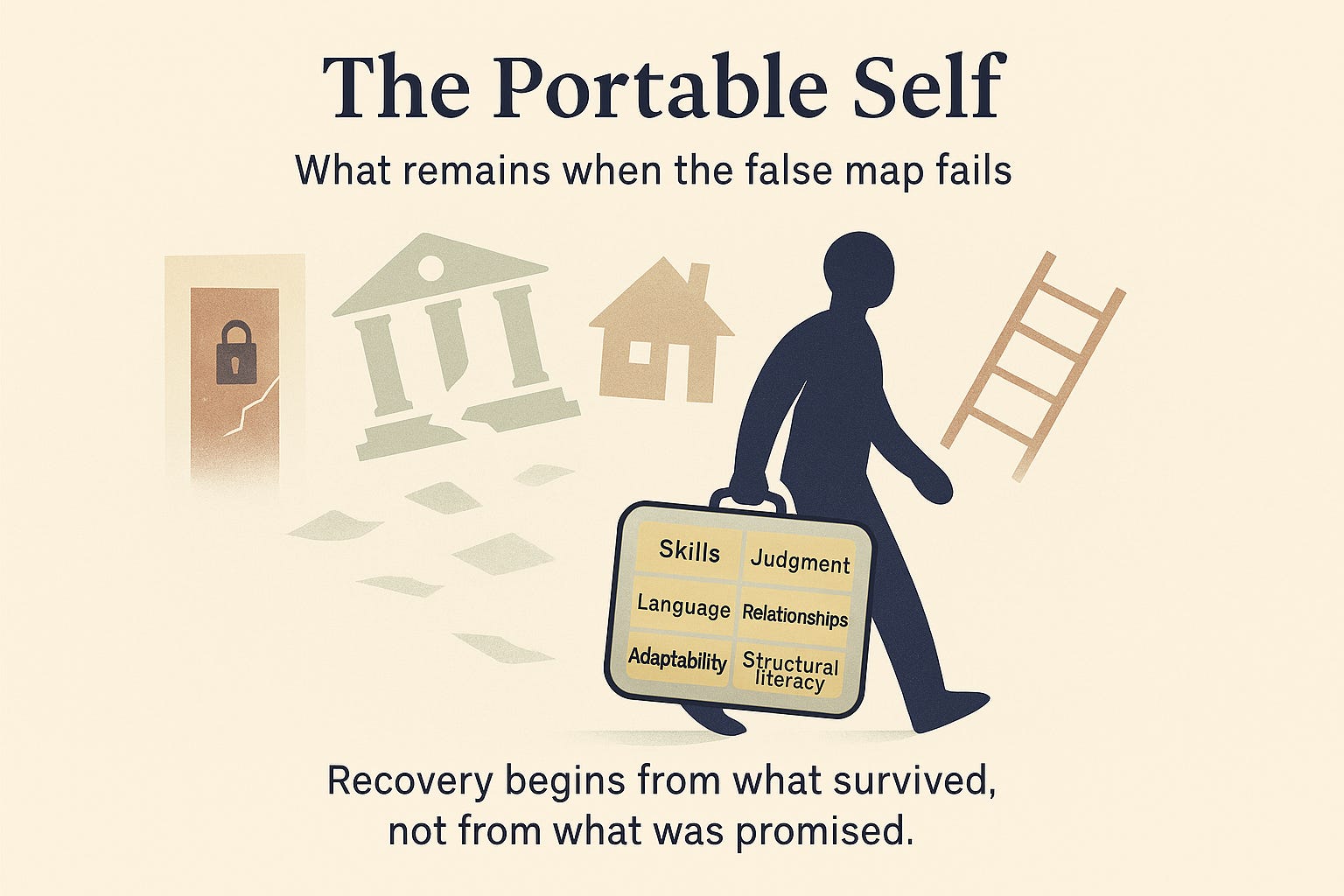
Third: rebuilding from what survived, not from what was lost. Winnicott observed that the false self, when it cracks, reveals a genuine self beneath it — suppressed, perhaps damaged by suppression, but capable of insisting on its existence. In the double error, the equivalent observation is that something always survives the double crisis — and that recovery must begin from what survived, not from an attempt to restore what was lost.
What survives varies. Skills developed over decades of work, even in misdirected careers, tend to be more transferable than the careers suggested. The immigrant who could not achieve homeownership has nonetheless developed navigational competence, linguistic range, cross-cultural fluency, and a network of relationships that have value independent of the specific economic outcomes that were pursued. The small business owner who lost two decades of investment has nonetheless developed operational knowledge, relationship capacity, and a specific kind of practical intelligence — the ability to manage under resource constraint, to improvise, to sustain motivation in the absence of institutional support — that is genuinely valuable even when the labor market does not know how to value it. The graduate whose credential did not deliver its promised return has nonetheless developed the intellectual discipline, the project completion capacity, and the credentialing-system literacy that, applied differently, may produce better outcomes.
The work of rebuilding from what survived requires the capacity to inventory honestly: to look at what the years of misdirected effort actually produced, regardless of what it was supposed to produce, and to identify what of that actual production is usable going forward. This is neither the consolation of “everything happens for a reason” nor the despair of “I have nothing to show for it.” It is a genuine accounting of what a life produces even when it is organized around the wrong framework — and it tends to reveal more than the despair suggests and less than the consolation claims.
Fourth: rebuilding the frameworks that were consumed, not just revising the frameworks that were wrong. The purely personal crisis requires primarily framework revision — the transition from a wrong category to a more accurate one. The double crisis requires this, but also requires rebuilding frameworks that were not wrong but were consumed: the trust in institutions, the willingness to make long-term investments in systems, the psychological capacity for sustained hope in the face of structural constraint. These are not false frameworks to be revised. They are genuine capacities that were depleted in the service of a false promise, and their depletion is a genuine loss that requires genuine rebuilding.
The Lebanese merchant who lost his savings to currency devaluation may need to revise his understanding of formal banking systems and sovereign risk — that is framework revision. But he also needs to rebuild the fundamental capacity for institutional trust that makes economic planning possible — and that rebuilding cannot proceed through the same cognitive processes that framework revision requires. It requires something closer to what the psychologist Mary Ainsworth identified as the experience of reliable responsiveness: the actual experience of institutions and relationships behaving in ways that justify the trust being rebuilt. This cannot be produced through individual insight alone. It requires actual encounters with more reliably structured systems — which is why geographical mobility, when it is available, is so often part of recovery from structural betrayal.
Fifth: the political dimension, which purely personal recovery cannot address. The original essay’s account of recovery ends at the individual level: a more accurate framework, a more capacious order of mind, a more genuine engagement with what the individual is actually building. This is necessary and important. It is not sufficient when the error was also structural.
Structural errors that persist — systems that continue to promise what they cannot deliver, to misrepresent the conditions of their own functioning, to attribute structural outcomes to individual causes — will continue to damage people regardless of how well any individual navigates their own double crisis. The individual who has passed through the double crisis with accurate diagnosis is in a specific and valuable position: they have knowledge of the system’s actual functioning that is not available from within the framework the system produces. They have, through the experience of the betrayal and the accuracy of its diagnosis, a form of structural literacy that is prerequisite to any genuine systemic change.
What to do with that literacy is a separate question — one that opens into political philosophy, collective action theory, and the history of social movements in ways that exceed the scope of a single essay. But the connection is real: the person who has accurately diagnosed a structural category error is not merely a victim of a wrong system. They are also, potentially, a witness to it — someone whose experience, if it can be articulated with the precision the diagnosis affords, contributes to the collective understanding that is prerequisite to structural change.
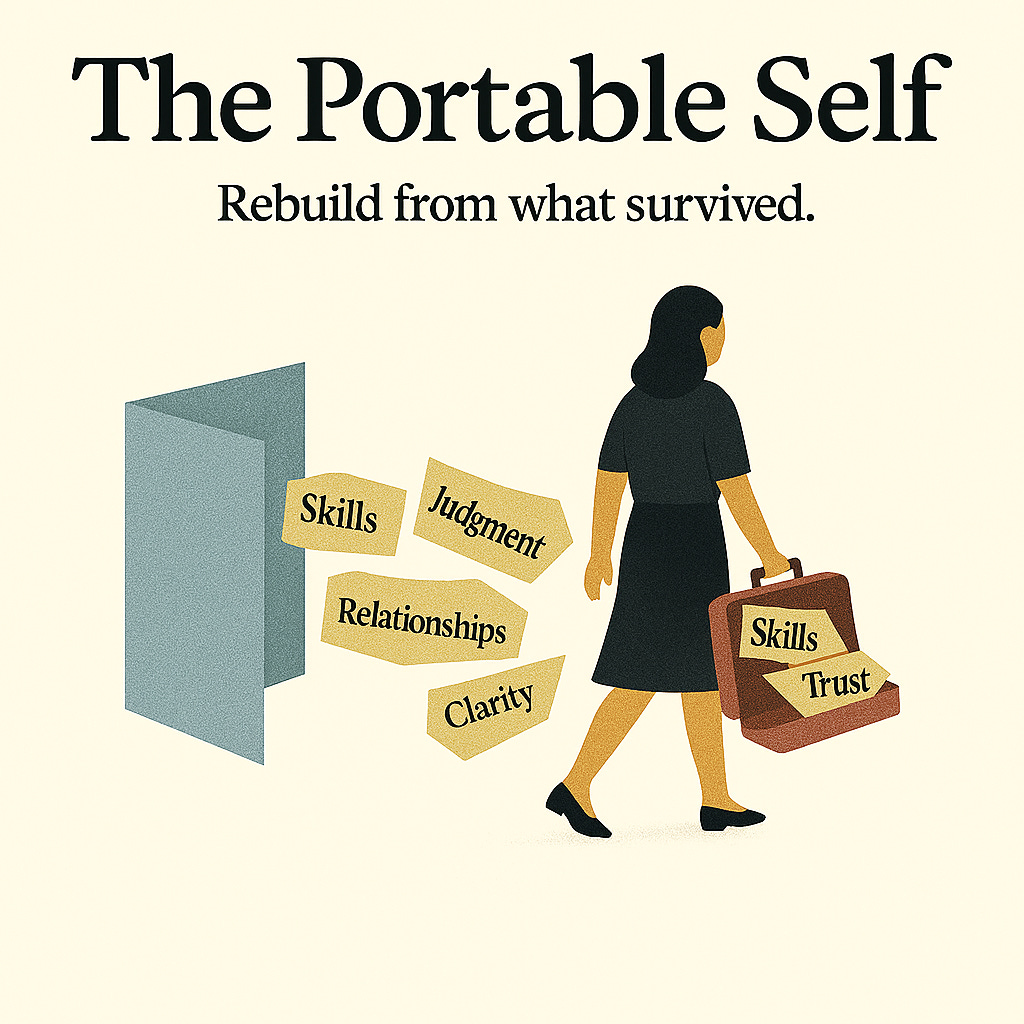
IX. The Portable Self: What Survives the Double Collapse and How to Build From It
In the analysis of personal economies under conditions of state fragility — the second essay in this series — the concept of portable human capital emerged as the primary asset in environments where everything fixed can be seized, inflated away, or destroyed. The skill that is globally valued, remotely deliverable, and cognitively non-confiscatable is the asset that survives what fixed assets cannot.
This concept applies with equal force to the recovery from double category error, and for the same structural reason. When both the personal framework and the systemic framework have been revealed as wrong — when both the map and the territory as presented have proven false — what survives is not the specific investments made within the wrong frameworks but the underlying capacities that those investments, however misdirected, actually developed.
The portable self is the inventory of what actually survived. It is what you know how to do, regardless of what context you learned it in. It is how you think, regardless of what the thinking was applied to. It is the relationships that were genuine, regardless of the instrumental frameworks within which they formed. It is the resilience capacity — the demonstrated ability to continue under constraint — that any sustained misdirected effort actually develops, even as it depletes other resources.
Building from the portable self requires a specific cognitive operation that is genuinely difficult: the ability to look at your accumulated experience not through the lens of the framework within which it was accumulated — which would reveal only its failure to produce the promised outcomes — but through the lens of what it actually produced regardless of its intentions. The immigrant’s years in Canada did not produce the middle-class life that was the framework’s promise. They did produce language mastery, cross-cultural navigation capacity, demonstrated resilience under structural constraint, and a network of relationships with people who have survived similar conditions and developed similar capacities. These are real assets. They are not the assets that were sought. They are what was actually produced.
The work of the portable self is an exercise in Bateson’s deutero-learning: learning at the level of frameworks rather than facts. Not “what did I accomplish within the framework?” but “what did the process of trying produce, independent of whether the framework was accurate?” The answer to the second question tends to be more than the despair of the double collapse suggests — because human effort, even misdirected, produces real capacities even when it does not produce the specific outcomes it was aimed at.
X. The Closing Argument: Cartography for the Double Lost
The visitor in Ryle’s original story needed, we said, not more facts but a better category — a different concept of what kind of entity he was looking for. The visitors in the cases examined in this essay needed something more demanding: not only a better personal framework but an accurate understanding of the institutional landscape they were navigating — one that was not provided to them, that was actively withheld from them, and that the systems they trusted had structural interests in preventing them from developing.
The diagnosis this essay offers is neither consoling nor condemning. It does not say: you should have known better. The frameworks within which these people operated were distributed by institutions with enormous prestige and material power, reinforced by social consensus, protected by the cognitive mechanisms that protect all frameworks from premature revision, and maintained against correction by the institutional interests that benefited from their maintenance. That these people believed in them is not a failure of intelligence or character. It is the normal operation of a social system designed to produce exactly that belief.
But the diagnosis also does not say: you are simply victims, and only structural change can help you. The personal dimension of the errors is real. The ways in which the frameworks were adopted, maintained, and deepened through personal sunk cost investment and identity fusion are genuinely within the individual’s domain. The work of accurate diagnosis — holding both the personal and the structural error clearly, without the consolations available in either direction — is genuinely available to the individual and genuinely productive.
What the double error demands, at the level of both the individual and the collective, is a more sophisticated cartography: maps that describe both the personal terrain — what you are actually pursuing, at what level, through what mechanisms — and the institutional terrain — what the systems around you are actually structured to deliver, for whom, under what conditions, and at whose benefit. This is harder to produce than either map alone. It requires the kind of structural literacy that the dominant frameworks are specifically designed to make difficult. And it is more necessary, precisely because the consequences of navigating by wrong maps — at both levels simultaneously — are what we have spent this essay examining.
The crisis that arrives when both errors accumulate to critical mass is not, ultimately, a punishment for credulity. It is a signal that the cartography has been wrong — at both levels, in both domains. And the work it demands — in its recovery, in its rebuilding, in its political implications — is the work of producing, and distributing, and insisting on more accurate maps.
Maps that describe the territory as it is, not as it was promised. Maps that acknowledge what systems are actually structured to deliver, and to whom. Maps that distinguish between personal errors that are correctable through individual development and structural errors that require collective response. Maps that honor both the genuine effort that was invested within wrong frameworks and the genuine betrayal of that effort by systems that knew — or should have known — the limits of what they were promising.
The visitor who has passed through the double crisis — who has survived both the personal framework’s collapse and the structural framework’s revelation — possesses something that neither crisis alone could have produced: a clarity about the relationship between individuals and institutions, between effort and structure, between what can be changed within a system and what requires changing the system itself. This clarity is hard-won. It is also genuinely valuable — to the individual who holds it, to the communities that share it, and to the collective projects of building systems that deliver what they promise.
That is the beginning of something more accurate than either map that was wrong.
This essay is a companion to “The Wrong Map: Category Errors, Misdirected Lives, and the Crisis That Corrects Them.” The intellectual traditions it draws on include, in addition to those cited in the original essay: Political sociology and hegemony: Antonio Gramsci’s “Prison Notebooks,” Stuart Hall’s work on encoding/decoding and representation. Inequality and social reproduction: Charles Tilly’s “Durable Inequality,” Pierre Bourdieu’s “Distinction” and “Reproduction in Education, Society and Culture.” Labor and precarity: Guy Standing’s “The Precariat,” David Weil’s “The Fissured Workplace.” Migration sociology: the literature on immigrant credential recognition barriers, labor market segmentation, and the “immigrant premium” debate. Housing and inequality: the economic literature on financialization of housing markets. Education and credentialism: Robert Frank’s “Falling Behind,” Randall Collins’ “The Credential Society.” Political economy: Colin Crouch’s “Post-Democracy,” Wolfgang Streeck’s “How Will Capitalism End?” Psychology of institutional trust: Mary Ainsworth’s attachment research, the empirical literature on institutional trust and recovery. Structural analysis of welfare states: Gösta Esping-Andersen’s “The Three Worlds of Welfare Capitalism.”
This essay is part of a series see index page here